ROVING PIANIST

WHO KNOWS WHERE HE WILL SHOW UP NEXT?

  • Home
    • Register
    • Log In
  • Concerts
    • Public concerts
    • Private Concerts
  • Quick Takes
  • Piano Blog
  • Other
  • Contact
  • About
    • About The Author
    • Privacy Policy
You are here: Home / Archives for Concerts

Grace Park and Joseph Liccardo at Central Park West

Monday, November 5th, 2018 by Ken Turner

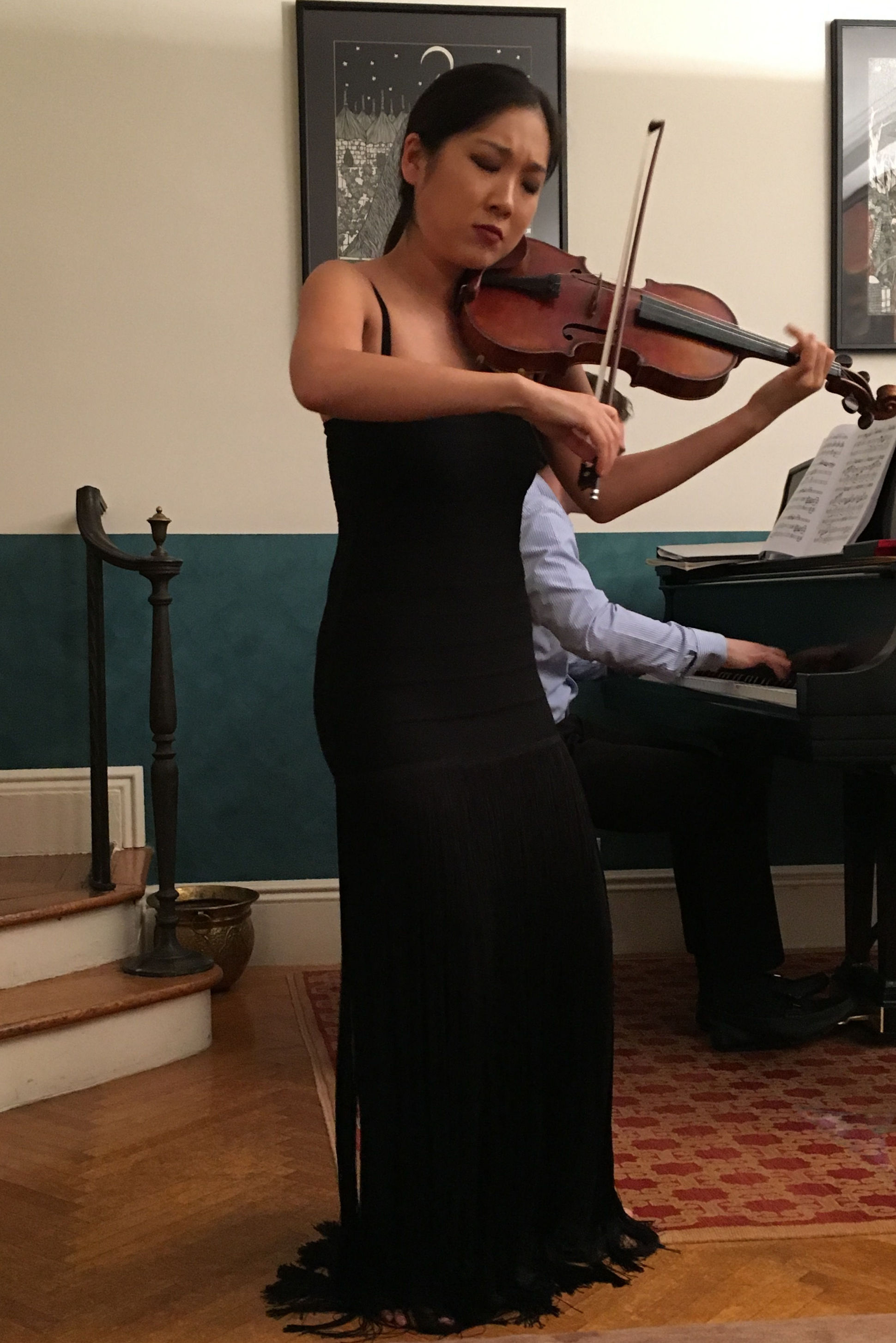
Grace Park playing a 1799 Nicolas Lupot violin at Central Park West

Grace Park with the 1799 Lupot violin

Grace Park and Joseph Liccardo

On Saturday November 3rd, 2018, violinist Grace Park and pianist Joseph Liccardo performed at Robin Shoemaker’s Central Park West salon.

My anticipation of this event grew when I learned that Ms. Park was playing a 1799 Nicolas Lupot violin.

Mozart: Sonata for Violin and Piano in E flat Major K. 481

The first movement contains lively dialog between violin and piano. Ms. Park and Mr. Liccardo maintained an apparently effortless coordination, allowing the Molto Allegro to flow naturally across the movement’s choppy phrasing.

In the Adagio, Ms. Park’s violin rose gracefully (sic) over the accompaniment, first as a slow dance and then to sing. In her hands this violin shone in the higher registers.

Overall, Mozart’s Sonata No. 33 was a well-balanced collaboration between two musicians who clearly loved what they were doing.

Brahms: Sonata No. 2 for Violin and Piano in A major Op. 100

This warm, entertaining work was at times expressively lyrical. At other times it was technically demanding. In fact, the Sonata was a showpiece for both musicians.

In that regard, there were moments when Joseph’s piano sounded as sweet as Grace’s exotic violin. And I enjoyed Ms. Park’s vibrant pizzicato immensely.

Neither musician wasted energy on superfluous showmanship. But I had to chuckle when Brahms got the violinist dancing around (apparently on bare feet).
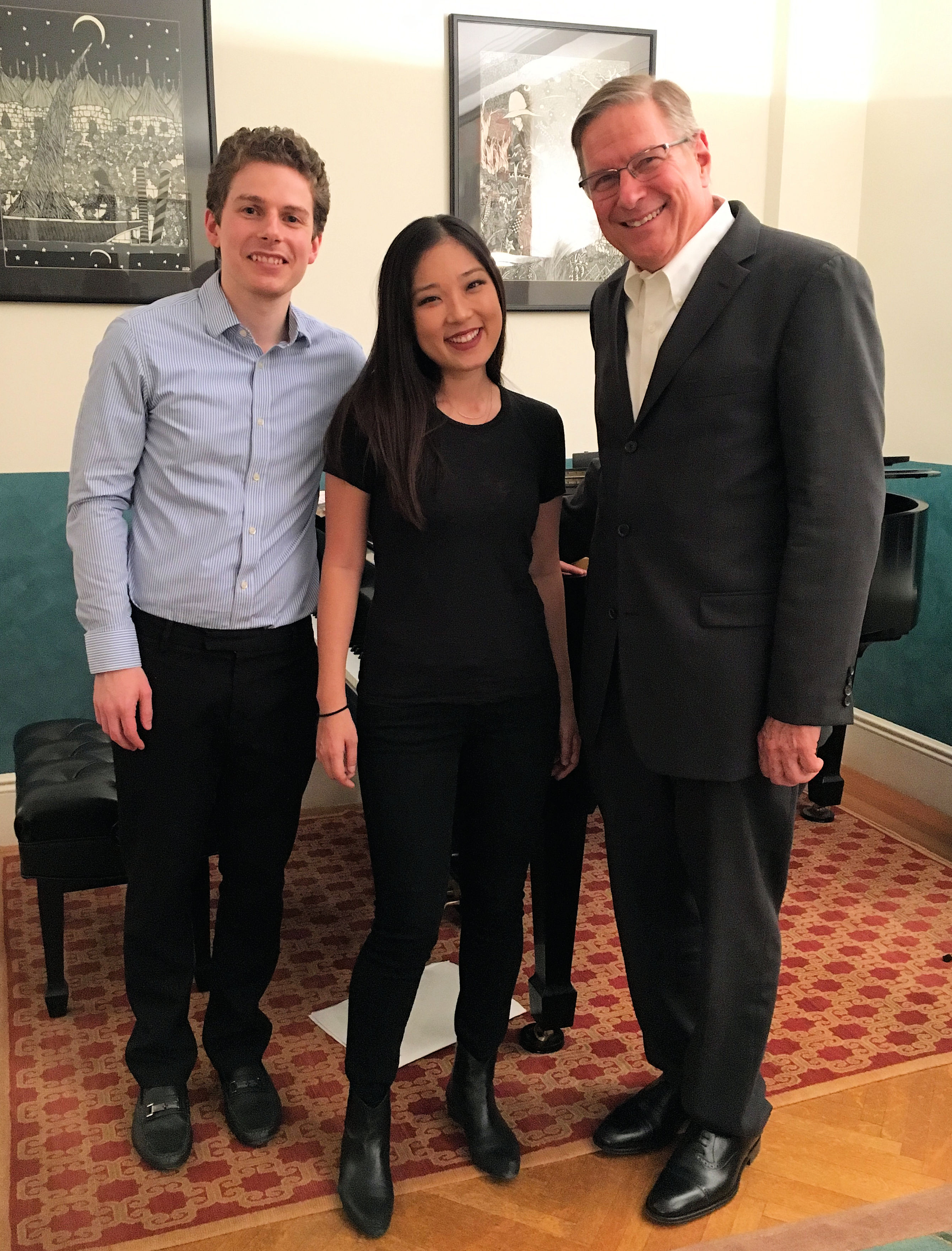
Grace Park with Joe Liccardo and Robin Shoemaker

Joseph, Grace and Robin Shoemaker

Tchaikovsky: Souvenir d’un lieu cher Op. 42

Souvenir is a wonderfully Russian work and quintessential Tchaikovsky.

There are pounding rhythms reminiscent of the 3rd movement of the 6th Symphony, and soaring melodies. The performers were equally at ease with both.

And again, the collaboration between pianist and violinist was perfect.

Stravinsky: Divertimento for Violin and Piano after ‘The Fairy’s Kiss’

This work is Stravinsky’s derivation (with violinist Samuel Dushkin) from his own orchestral ballet “The Fairy’s Kiss”, which in turn was based on songs by Tchaikovsky.

That said, Divertimento is very much Stravinsky’s own unique work, with manic dance rhythms and echoes of his other compositions.

Notwithstanding that they had already been playing for an hour, Mr. Liccardo and Ms. Park engaged Stravinsky with vigor and enthusiasm. The result was a highly enjoyable and often compelling performance.

Nicolas Lupot Violin

Some refer to Lupot as the “French Stradivarius”. I didn’t know what to expect of such a unique instrument as his 1799 violin from Paris, but I noticed a particular sweetness in the upper middle register.

Later I asked Ms. Park what it is like for her to play the Lupot. She responded that the instrument is in perfect condition, very responsive to the performer, and crystal clear especially at the top end.

“It sparkles differently than a Strad”, she said. “I love it.”
Filed Under: Concerts, Private Concerts Tagged With: Brahms, Grace Park, Joseph Liccardo, Mozart, Nicholas Lupot, Nicolas Lupot, Robin Shoemaker, Stravinsky Divertimento, Tchaikovsky, Violin

Carnegie 2018: Take It or Levit

Saturday, October 20th, 2018 by Ken Turner

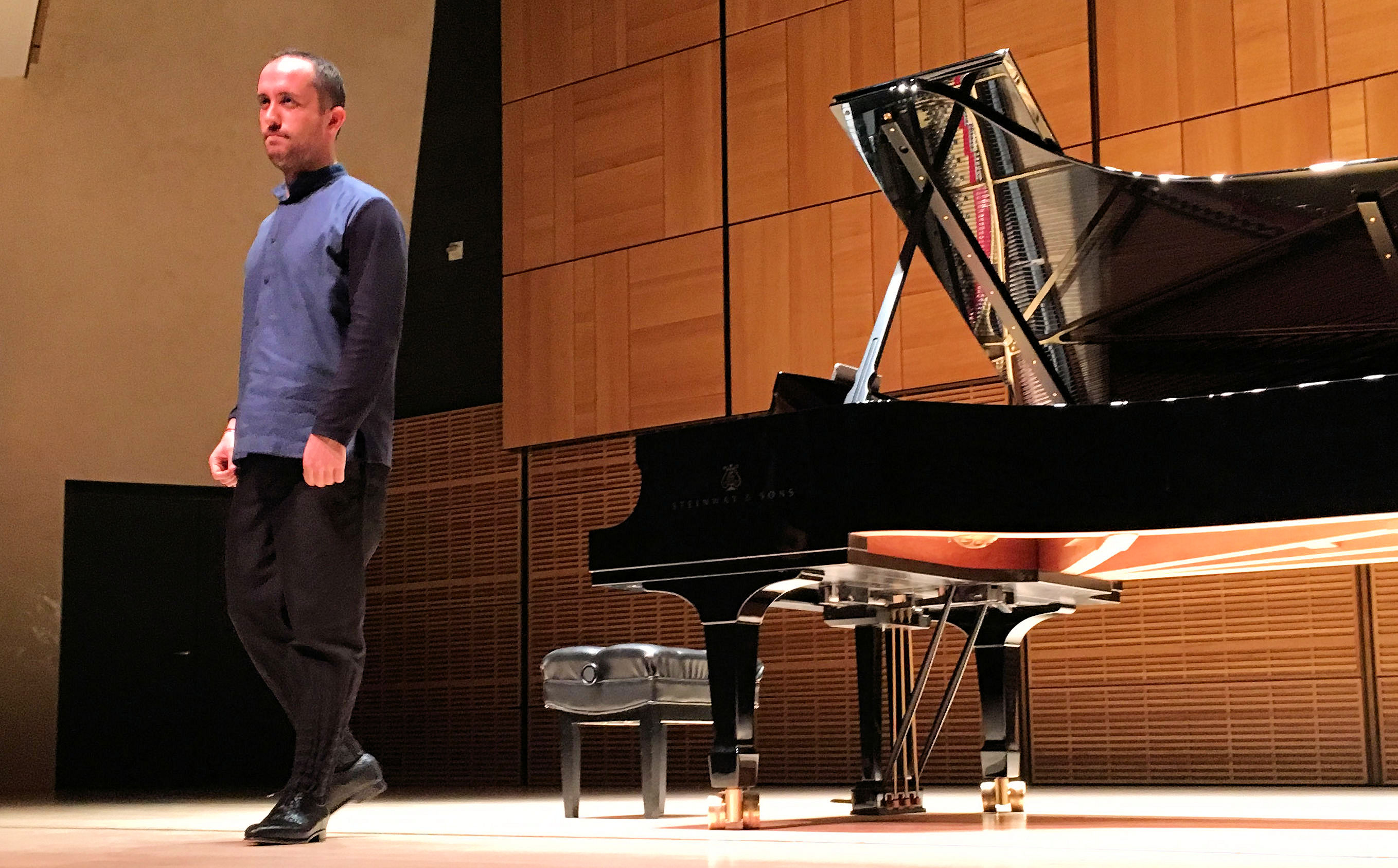
Igor Levit, Carnegie Zankel October 2018

Igor Levit at Carnegie Zankel October 2018

Igor Levit’s 2017 Carnegie recital was described by one reviewer as “a peak pianistic experience of my concertgoing life”.

I signed up for Levit’s 2018 Carnegie recital hoping for just such an experience.

However for me the repertoire of the October 19th recital alone was sufficient reason to subscribe.

And so, after gorgeing ourselves at the Brooklyn Diner on West 57th Street, my dear wife and I entered Carnegie Zankel stuffed with great food and full of expectations.

Bach: Chaconne in D Minor (left hand, arr. Brahms)

I have attended strong two-handed performances of Bach’s D Minor Chaconne (arr. Busoni) by Han Chen and Virna Kljakovic. However Igor Levit was my first live experience of Brahms’ left hand arrangement. I had great hopes for it, because the underlying Partita is superlative.

Bach Partita #2’s Chaconne soars to spiritual heights and sinks to the edge of despair (over the death of Bach’s wife, some say).

But when compared with the edgy clarity of Hilary Hahn’s violin or the harmonic density of Busoni’s two-handed arrangement, Levit’s Chaconne felt as cold as the stone of a cathedral. Somewhere between Brahms and this pianist, the flame went out.

Busoni: Fantasia after J.S. Bach, BV 253

As per Busoni, Fantasia opens serioso, sostenuto e sempre sottovoce. In Levit’s hands, these directions were faithfully executed.

From my front row right seat, I had a great view of Levit’s sostenuto. I was able to see how he worked the pedals to create ethereal tones in higher registers. He used much partial pedal to thread the hazardous path between too little resonance and too much.

I could literally see the resulting harmonics hanging in the air. They looked like a church organ, with harp-like strings in place of pipes.

Mr. Levit’s performance of this work was the high point of his recital, and utterly mesmerizing. You can hear him play this for yourself at Igor Levit plays Busoni Fantasia nach J.S. Bach – live 2015.

Schumann: Variations in E-flat Major on an Original Theme

This serene but unremarkable work left your reviewer unmoved. This was not through any fault of Mr. Levit. Schumann never has done much for me. Perhaps you, dear reader, will get more out of Igor Levit’s Variations in E-Flat Major on an Original Theme “Ghost Variations”, WoO 24 than I did.

Wagner: Solemn March to the Holy Grail from Parsifal (arr. Liszt)

The Solemn March opens with a descending bass motif that sounds like huge bells tolling over a stately procession. The bells continue throughout the work, giving it a gravitas that fitted the rest of the recital program. Although there are more dramatic performances, I personally appreciated Mr. Levit’s understated interpretation.

Liszt: Fantasia and Fugue on Ad nos, ad salutarem undam (arr. Busoni)

Liszt is the kind of composer you either love or you hate. My wife and I are at opposite ends of this spectrum, but I have to agree that this brash, showy work does not inspire me the way even the Parsifal arrangement did.

In my opinion Mr. Levit could profitably have dropped this work from his program, buying him time for a couple of encores that would have greatly endeared him to his neglected Carnegie audience.

Frederic Rzewski “A Mensch” from Dreams, Part I [encore]

Mr. Levit announced that he would play only one encore. Disappointing as this was, it is hard to imagine following a program of such gravity with any kind of casual crowd-pleaser.

Indeed, A Mensch was no crowd-pleaser. Your unfortunate reviewer neither liked nor understood this awkward, atonal work. For future performances, it would help if Mr. Levit would grace his audience with a brief musical introduction.

What was the point of the pianist rapping the piano with his fingers, or the closing moment when he slid his foot off the damper pedal so that it sprang up with a loud CLACK?

Igor Levit: one of a kind

When Mr. Levit was ready to start Busoni’s Fantasia, a latecomer was being seated. Whatever he may have felt, Levit flashed a good-natured smirk at the audience. It was a reassuring moment, and one of many indications that although Igor Levit is a different kind of pianist, he is still human.

There were cases where Mr. Levit’s individuality was less impressive. At the end of Busoni’s Fantasia, and again at the end of Liszt/Wagner’s Solemn March to the Holy Grail, the audience waited politely for the pianist to sit up and indicate that he was finished. Instead, Levit started the next part of his recital. These were awkward moments, verging on rude.

There were other moments that I could cite to illustrate Mr. Levit’s uniqueness, but I will trade them all for the answer to one question. When you were sight-reading from your iPad, Mr. Levit, I did not see a page-turner pedal. So how did you turn the page?


Filed Under: Concerts, Public concerts Tagged With: Bach, Busoni, Carnegie Hall, Carnegie Zankel, Chaconne, Frederic Rzewski, Han Chen, Hilary Hahn, Igor Levit, Liszt, Schumann, Virna Kljakovic

Pianist Zhenni Li and Partners at Central Park West

Saturday, October 6th, 2018 by Ken Turner

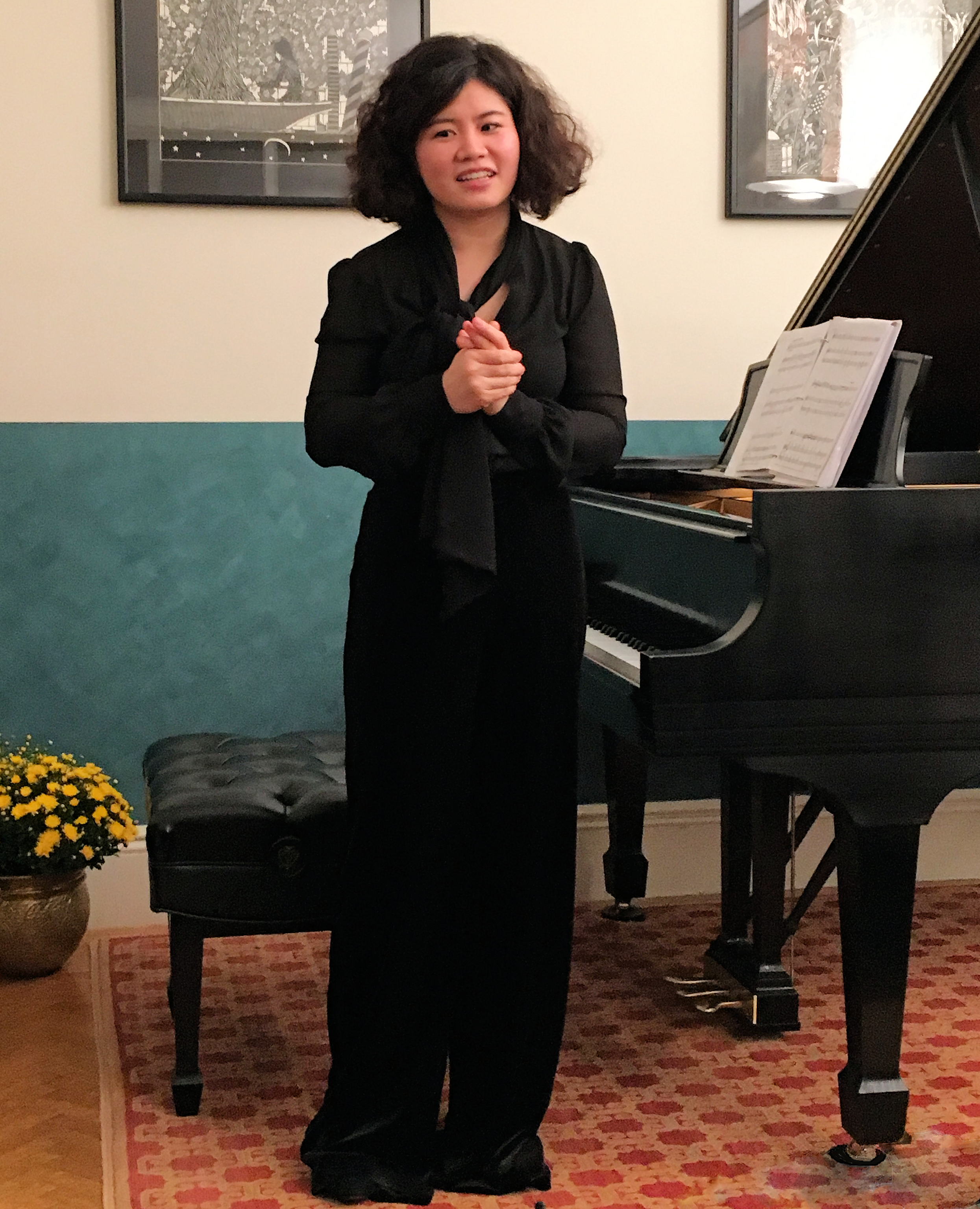
Zhenni Li addressing her salon audience

On the evening of October 6th 2018, Robin Shoemaker’s salon was full to capacity. We had come to see pianist Zhenni Li perform both as a soloist and in collaboration with Matthew Cohen (viola),

The program started and ended with works by Beethoven and Mussorgsky. An interesting mix of early 20th century pieces fleshed out the middle.

We were not familiar with some of these works, but Ms. Li introduced each item to us.

Beethoven: 32 Variations in C minor

This work is quintessential Beethoven, vigorous and lean. While Beethoven purportedly was unhappy with the result, Zhenn Li’s rendition was strong and satisfying.

Debussy: Poissons d’Or

Debussy’s short work is playful and at the same time beautiful. In Ms. Li’s nimble hands it was a delightful contrast to the solemnity of Beethoven’s variations.

Edwin York Bowen: Phantasy for Viola and Piano, Op. 54

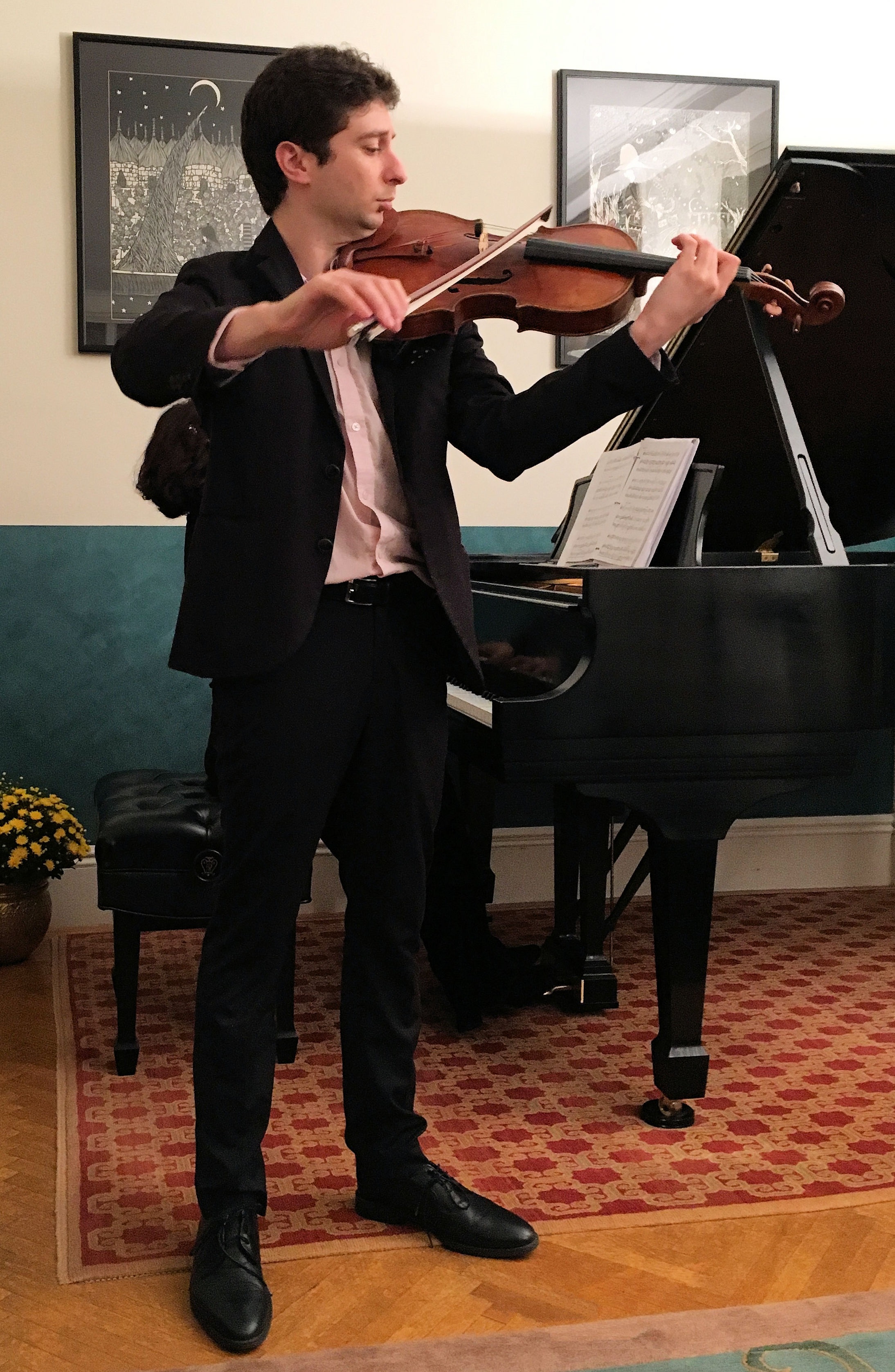
Matthew Cohen

For York Bowen, Ms. Li partnered with Matthew Cohen (viola). While the work is not so well-known, there are a number of performances on YouTube including one by Mr Cohen himself, working with pianist Vivian Fan: Bowen Phantasy.

If Mussorgsky’s Picture at an Exhibition is a set of imposing oil paintings, York Bowen’s Phantasy is a pastoral water-color.

At times the composer gets lost in his English meadows. But he also manages a sublime lyricism that allowed Matthew Cohen’s potent vibrato to sing. And as Ms. Li noted, there were echoes of Rachmaninov near the end.

Albéniz: Navarra

One of Albeniz’ pupils finished this work after Albeniz passed away. Before playing it, Zhenni Li challenged us to identify point where the student took over. Then she played this lively and very Spanish music with passion, at times throwing her head back as if transported.

The late Alicia de Larrocha gave a legendary performance of this work in 1968.

Arthur Lourié: Préludes Fragiles Op.1, No. 4

This impressionistic prelude was one of a suite of 5 written early in the 20th century by Russian composer Arthur Lourié. Although written long before Lourié moved to France, it sounds somewhat French to your reviewer. You can view Zhenni’s recording of it at Arthur Lourié: Prélude #4 from Cinq Préludes Fragile, Op. 1 – Zhenni Li, Piano.

Mussorgsky: Pictures at an Exhibition

To enhance our appreciation, host Robin provided a slide show containing paintings and other visuals for each section of Mussorgsky’s work. While the piece is best known in Ravel’s orchestration, Mussorgsky’s original piano version has become more popular lately. While some may find the work ponderous, Zhenni Li’s interpretation used iridescent harmonics to add magic to this magnificent work.

Encore: Piazzola’s Oblivion

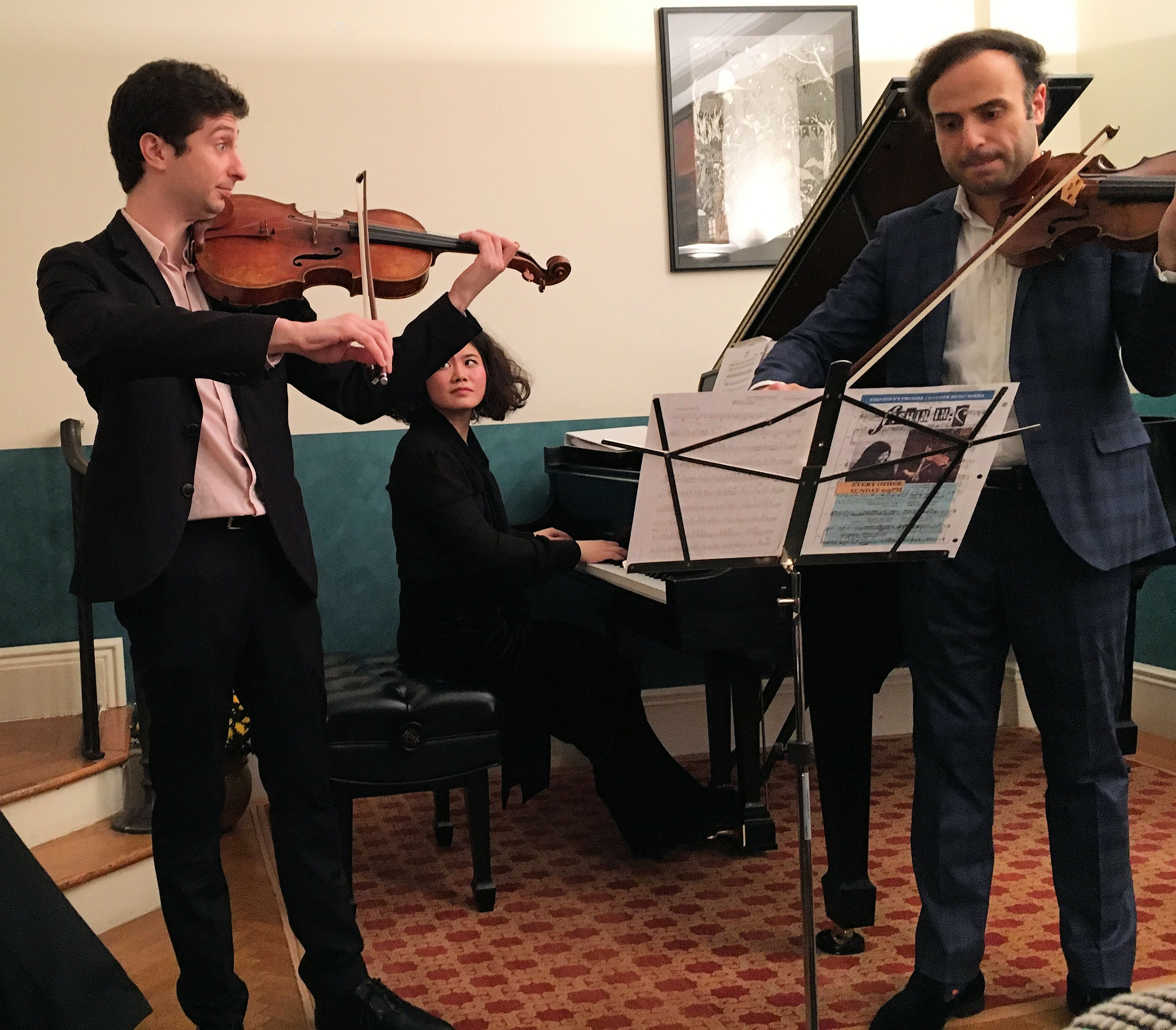
Matthew, Zhenni and Bela cue for Piazzola

At the close of the recital. Zhenni Li announced a surprise guest and a special encore.

Violinist Bela Horvath then joined with Zhenni and Matthew to play Piazzola‘s 1982 tango Oblivion.

Some consider this work to be among the most beautiful music ever written. The performance was rapturous, and drew cheers from the audience.

It’s not just the performers

It’s neat to meet musicians who perform at Mr. Shoemaker’s concerts. But the salon experience is not just about watching people play and meeting them afterwards. It’s also about the program.

Often, there is music that we are not familiar with. At Zhenni Li’s recital, I discovered Astor Piazzola, the Argentine composer who wrote Oblivion. Piazzola is known for revitalizing the tango by adding jazz and other elements to form nuevo tango. This led me order a CD of his 1987 Central Park Concert.

Thank you Robin, Zhenni and partners, for broadening our musical horizons.

Filed Under: Concerts, Private Concerts Tagged With: Astor Piazzola, Baba Yaga, Beethoven, Bela Horvath, Lourié, Matthew Cohen, Mussorgsky, nuevo tango, Oblivion, piano, viola, Violin, York Bowen, Zhenni Li

« Previous Page
Next Page »

©2025 Ken Turner | Roving Pianist


Loading Comments...
 

You must be logged in to post a comment.