ROVING PIANIST

WHO KNOWS WHERE HE WILL SHOW UP NEXT?

  • Home
    • Register
    • Log In
  • Concerts
    • Public concerts
    • Private Concerts
  • Quick Takes
  • Piano Blog
  • Other
  • Contact
  • About
    • About The Author
    • Privacy Policy
You are here: Home / Archives for Ken Turner

Santa Barbara Piano Retreat: A Transformative Experience

Friday, November 14th, 2025 by Ken Turner

2025 Piano Retreat [Photo: Kim & Kim Piano Academy]

2025 Piano Retreat [Photo: Kim & Kim Piano Academy]

Why I chose this Piano Retreat

I began learning piano at age 63. The first few years went well, but like so many adult learners I plateaued.  To counter this I took evening classes in piano at Juilliard. They were helpful, but I continued to struggle with accuracy and performance anxiety.

in 2023 I experienced an on-stage disaster at Blue Gallery in New York. I was performing a prelude that I had played at Carnegie Weill some years before. This time I couldn’t recover from an error. The experience shook me. I wondered if I was just getting too old.

Then I read pianist Jeeyoon Kim‘s book Whenever You’re Ready: How to Compose the Life of Your Dreams. Beautifully designed and full of wisdom for adult amateur pianists, it gave me hope.

This led me to the Kim & Kim Piano Academy, created by pianist Jeeyoon Kim and conductor/violinist/pianist Anthony Do-Hoon Kim. I took their online course How to Practice Piano 101. I enjoyed it, but felt that it would have been better to attend in person.

So when the Santa Barbara Piano Retreat for Adult Amateur Pianists was announced, I signed up promptly. The venue was the Music Academy of the West in Santa Barbara, CA. It looked perfect, lovely inside and out. We rented a house close by, just a few minutes’ walk from Butterfly Beach in Montecito.

Note: This retreat was formerly known as the Kim & Kim Piano Retreat.

What the Retreat Offered

The 4-day retreat was centered around student performances, providing multiple opportunities to be coached and to learn by observation.

Masterclasses

Each student brought personal repertoire to work on throughout the retreat. Masterclasses allowed us to perform in front of each other and receive professional guidance from Jeeyoon and Anthony.

Private Lessons

We also received one-on-one lessons with both Jeeyoon and Anthony. Another teacher, Natasha, coached our assigned duets. This mix of solo and collaborative performance provided enough variety that we had lots of fun and never felt overworked.

Roundtables and Workshops

There were Roundtables where we discussed topics such as how to adjust to the uniqueness of an individual piano, and Piano Workshops where we considered interpretational and technical skills.

Anthony and Jeeyoon

Final Concert

The retreat culminated in a public recital in Lehmann Hall on a fine Hamburg Steinway. Students got to perform what they had been working on. The event was recorded and is being edited by Kim & Kim for distribution to students.

Practice Environment

Classes were interspersed with practice time in private rooms away from the main teaching area, so that students could harden new skills and work on their repertoire. All pianos were Steinway grands, in good condition and IN TUNE.

Welcome dinner in the courtyard

Welcome dinner by Kim & Kim

Community and Daily Life

After the initial welcome dinner, meals were not provided. However we ate together most of the time. Jeeyoon would coordinate lunch deliveries, and in the evening we would head into town for dinner.

To their credit, Jeeyoon and Anthony were with us all day, from the first class to the end of dinner. Their dedication went beyond the normal teacher-student model, making us feel like one big happy family of musicians.

Coaching That Improved My Playing
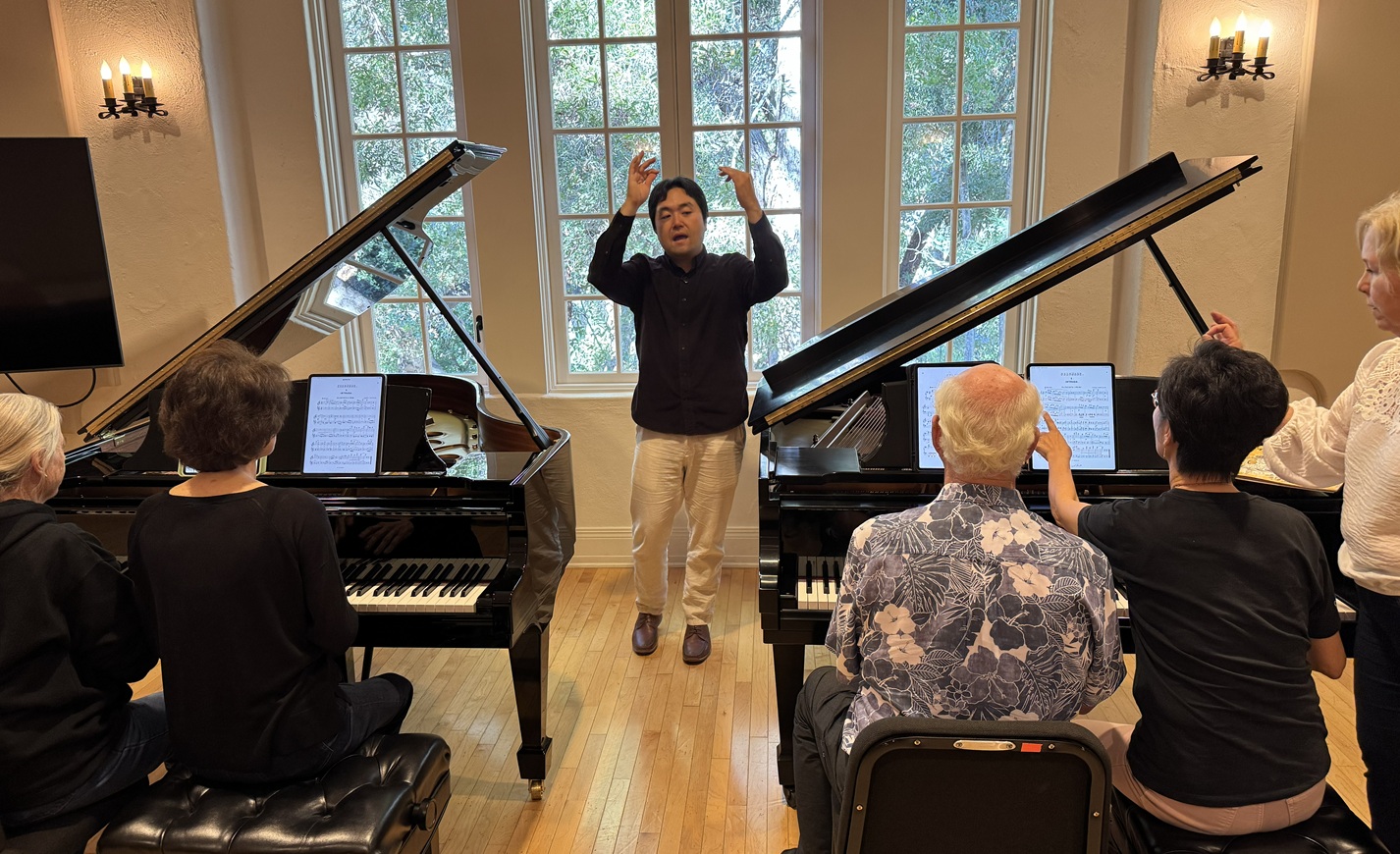
Anthony’s style!

Anthony’s Approach

Anthony was my coach for Bach’s Prelude #1 in C Major BWV 846. Being a conductor, what did he do? He CONDUCTED my Bach! Arms outstretched, he sculpted the rise and fall of the dynamics in line with Bach’s harmonic structure. The result may not have been for Bach purists, but on a modern piano it was exhilarating.

Jeeyoon’s Approach

My biggest struggle is recovering after a mistake. This had caused my 2023 performance collapse. During my Beethoven lesson with Jeeyoon, it happened again. I stopped several times, having lost my place in the music.

Unexpectedly, Jeeyoon handed me several handwritten notes. Each contained a recovery point with bar numbers and memory cues. She had me practice jumping to them again and again until they started to stick. Then I went to the practice room and worked them some more.

Jeeyoon has a remarkable ability to pinpoint the root of a performance issue and provide a solution. At the recital, my Beethoven was exactly what I had hoped for. I could not have been more grateful.

Personal Growth

These are the benefits I gained from attending this retreat. I could not have achieved them by myself.

  • My Bach Prelude is now bigger and better
  • I performed Beethoven in public with no breakage
  • I gained practical experience with predesigned recovery points
  • I recovered my on-stage confidence

Who This Retreat is Ideal For

Roving Pianist recommends the Santa Barbara Piano Retreat for Adult Amateur Pianists wholeheartedly for:

  • Adult amateur pianists at any level
  • Late-life beginners (like me)
  • Pianists who want to improve confidence on stage
  • Pianists looking for a supportive group environment
  • Pianists who want to improve their musical interpretation

Would I Attend Again? YES!

The Santa Barbara Piano Retreat (formerly the Kim & Kim Piano Retreat) was far more than some classes. It was 4 days of musical immersion, personal growth, and connection. The beauty of the campus, the warmth of the community, the expertise of the instructors, and the well-crafted syllabus: everything came together as an unforgettable life experience.

The Piano Retreat Experience
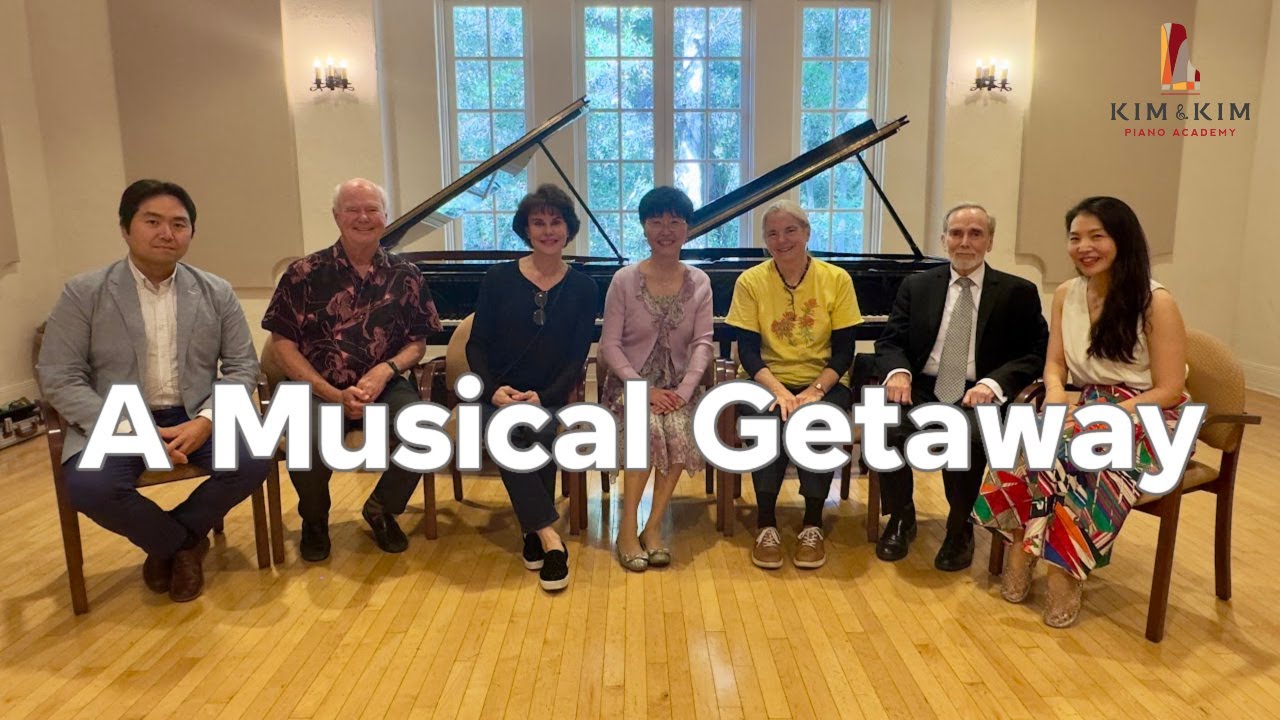
[Video courtesy of Kim & Kim Piano Academy]

Roving Pianist is an independent blog and receives no compensation for this article.

Filed Under: Piano Blog Tagged With: Adult Amateur Pianist, Anthony Do-Hoon Kim, Anthony Kim, Jeeyoon Kim, Kim & Kim Piano Academy, Kim & Kim Piano Retreat, Lehmann Hall, Music Academy of the West, Piano Retreat, Santa Barbara, Santa Barbara Piano Retreat

Mateusz Mikolajczak at Kosciuszko Foundation NYC

Saturday, March 29th, 2025 by Ken Turner

Mateusz Mikolajczak at Kosciuszko Foundation

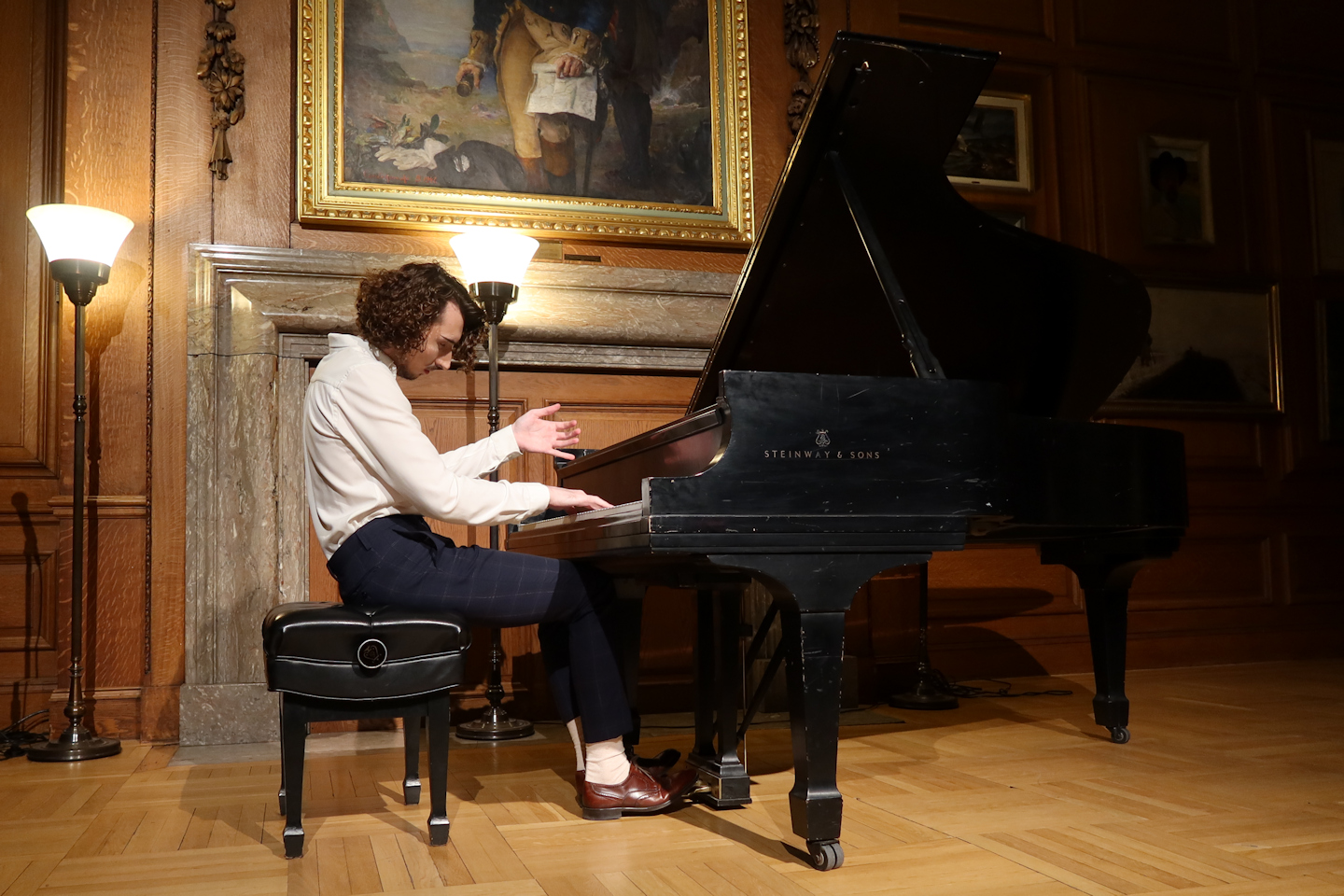
On March 26, 2025, the Kosciuszko Foundation presented a piano recital by Polish pianist Mateusz Mikolajczak. The event was held in the concert hall at their headquarters a block from Central  Park.

The concert hall was itself a work of art, its wood-paneled walls covered with fine paintings.

The Steinway grand piano looked like a well-used music academy instrument, but sounded great.

Chopin: Nocturne in C-sharp minor, Op. 27 No. 1

I loved Mr. Mikolajczak’s performance of this, one of my favorite Chopin’s Nocturnes. I caught myself thinking here I am, listening to an accomplished Polish pianist play this riveting work written 189 years ago. Maybe it’s time I made a pilgrimage to Poland.

Liszt: Sonetto 104 del Petrarca from Années de Pèlerinage

I had mixed feelings about Mikolajczak’s Liszt. While the pianist swayed back and forth with the phrasing and made artful gestures with arm and hand, the piano did not convey such emotional weight. I speculate that perhaps body language was at the expense of pianistic expression. Readers might compare Yunchan Lim’s performance. 

Chopin:  Polonaise-Fantaisie in A-flat major, Op. 61

The Polonaise-Fantaisie can feel a bit rambling. However Mikolajczak’s delivery gave me a new respect for the piece. I became fascinated by how Chopin’s themes and motifs would leave and later return with renewed magic.

Beethoven: Piano Sonata No.23 “Appassionata” Op. 57

Tantalizing fragments of Beethoven echoed down the stairwell while Mikolajczak was rehearsing.

But nothing could prepare me for sitting in the front row while he performed Beethoven’s Appassionata. He was compelling.

So much vigor and drama, such crisp, virtuosic delivery! We loved it, giving the pianist a standing ovation.

Prokofiev’s Piano Sonata No. 8 in B-flat major, Op. 84

I am amazed that anyone can play this elaborate work from memory. But Mateusz Mikolajczak seemed to thrive on Prokofiev’s unusual tonalities and relentless, driving rhythms. However I noticed toward the end of the last movement that the tips of the pianist’s fingers had become dark pink.

My favorite moments in this work were the tantalizingly evanescent “ocean swell” phrases, when Mikolajczak made us feel like we were on a ship in heaving seas, the pianist rising from his bench to stay in control.

Mateusz MikolajczakClosing Thoughts

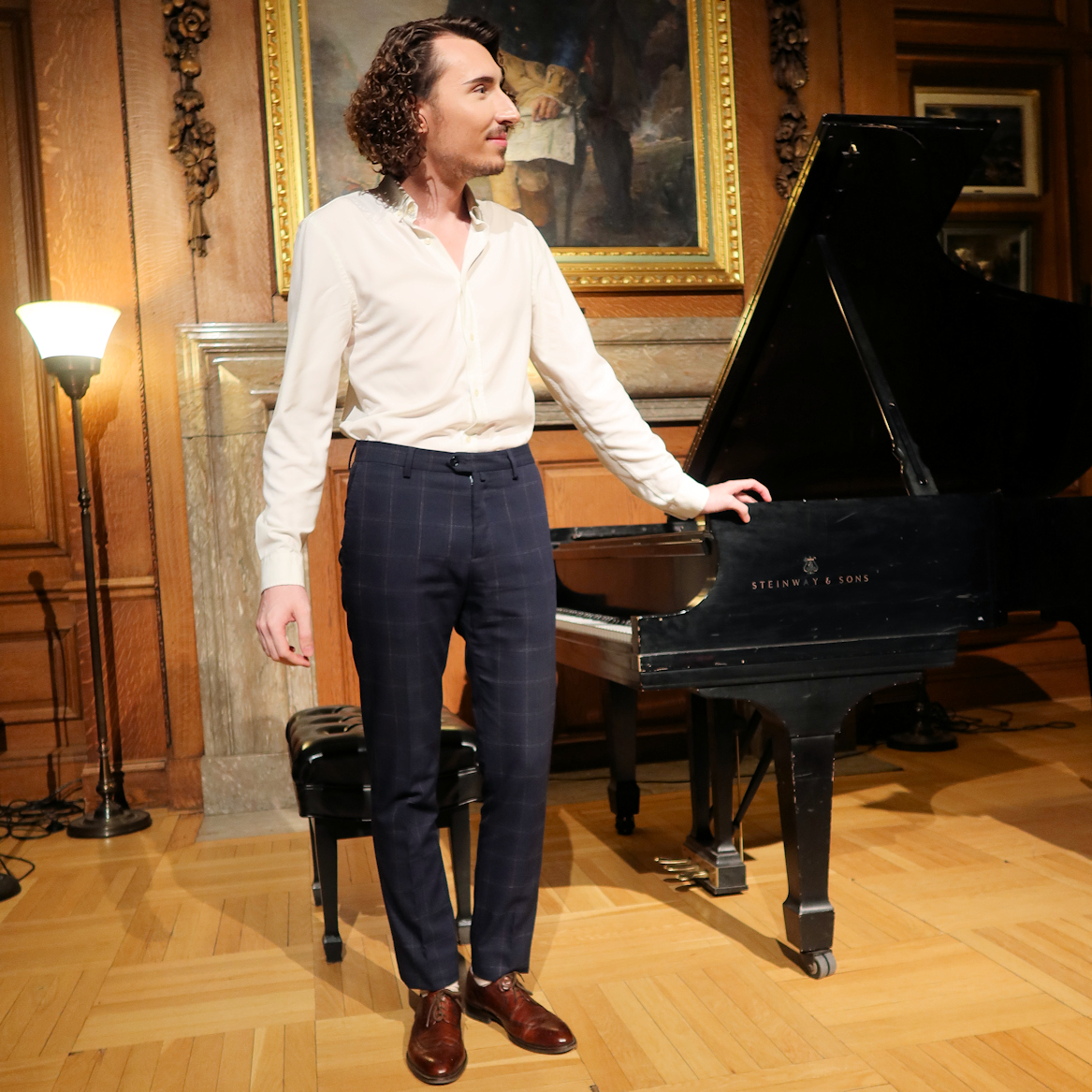
The pianist’s profile and curly hair made me think of European aristocrats from a bygone age. His interactions with his audience were correspondingly gracious, but brief.

Much of the time at the piano, his hair fell over his face. I wanted to know more about who this fascinating pianist was, but he was immersed in his art so that would have to come later.

Mateusz Mikolajczak is a classy performer with immense concentration, impressive technique and a flair for drama. I would be interested to hear his interpretations of Bach/Busoni or Bach/Liszt.

The Kosciuszko Foundation

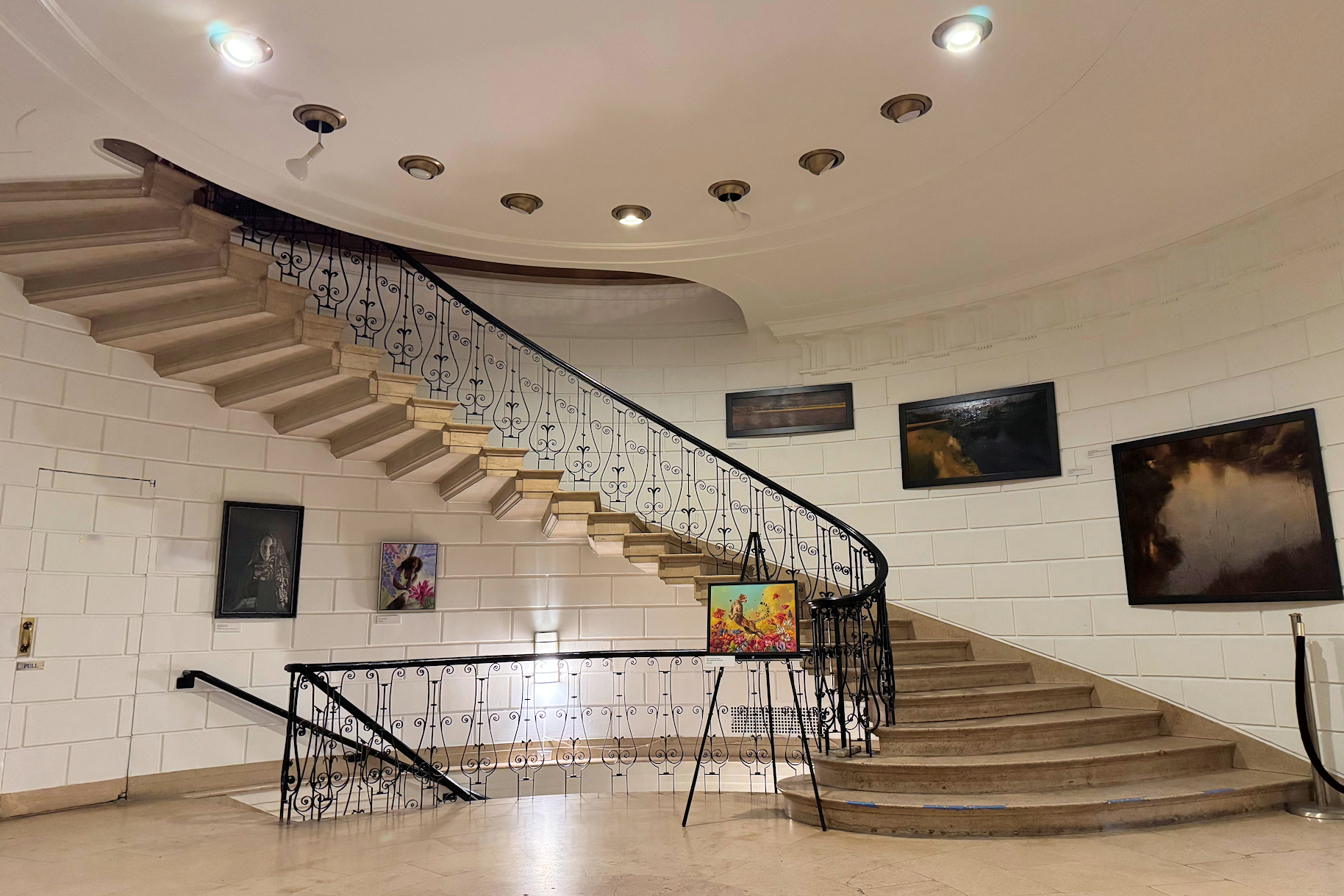
Rotunda at Kosciuszko Foundation NYC

The Rotunda at KF

The membership-supported Foundation promotes educational and cultural exchanges between the United States and Poland. Their premises at 15 East 65th Street provided the perfect venue for this recital.

The Foundation, its people, and the good work that they do thoroughly impress me.

Special thanks to Ewa Zadworna for facilitating my attendance and discreet use of a camera.

Filed Under: Concerts, Public concerts Tagged With: Appassionata, Beethoven, Chopin, Ewa Zadworna, Kosciuszko Foundation, Liszt, Mateusz Mikolajczak, Polonaise-Fantaisie, Prokofiev

Flutist Ginevra Petrucci and Pianist Matthieu Cognet in NYC

Thursday, March 6th, 2025 by Ken Turner

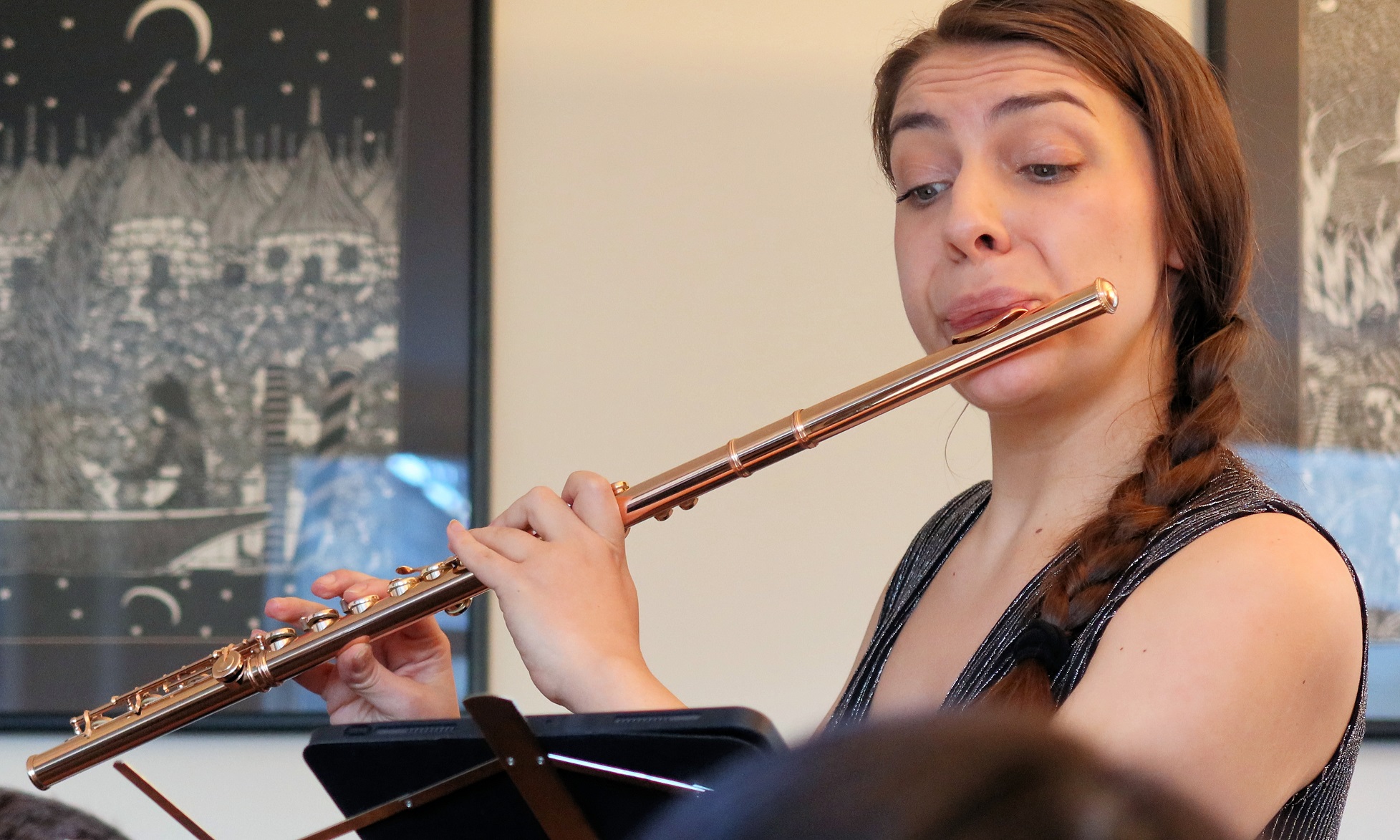
Petrucci and the Golden Flute

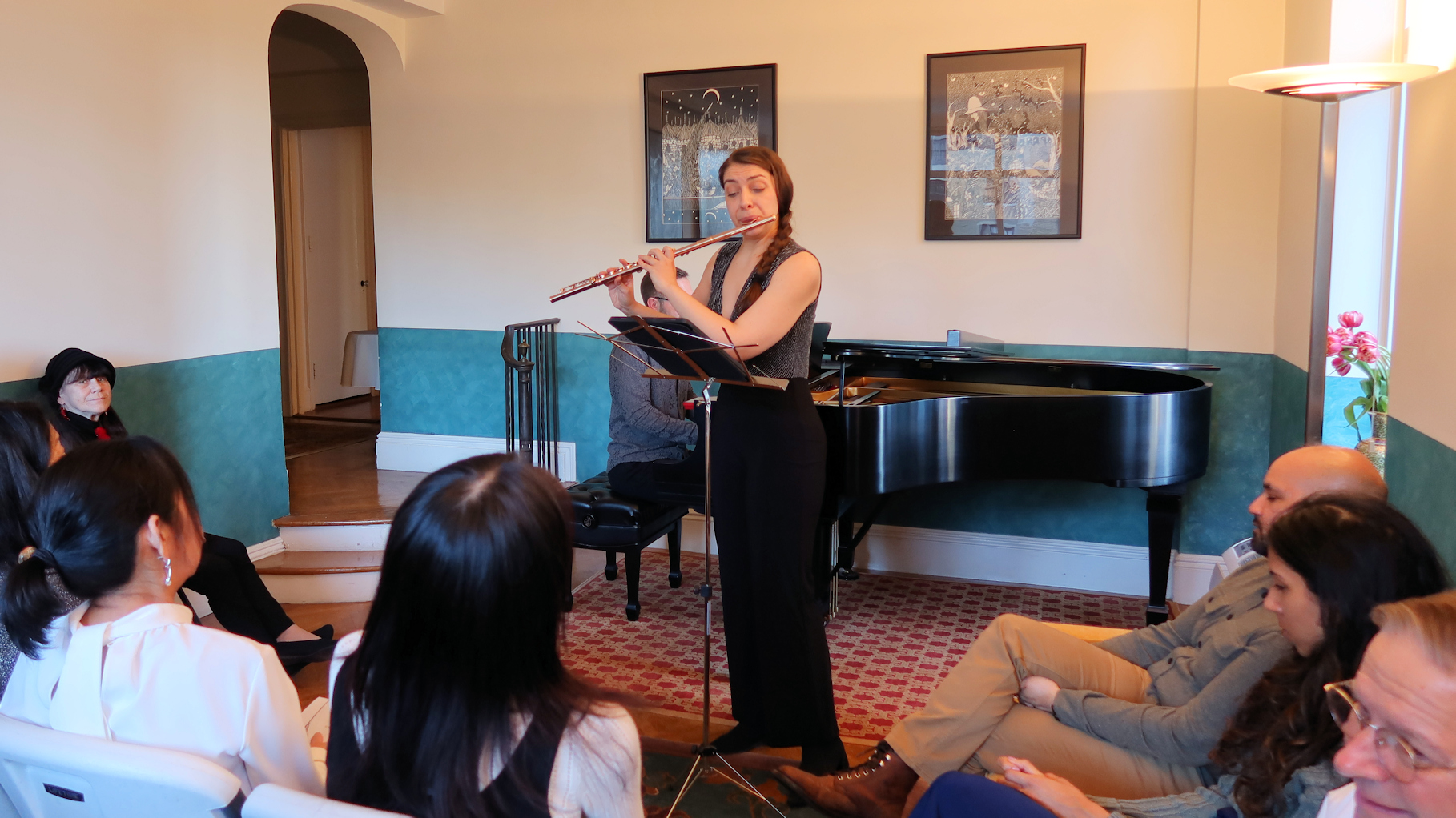
Ginevra Petrucci performing in New York, March 2025

On March 2nd, 2025, I was privileged to attend the Shoemaker Salon for an all-French recital by Italian flutist Ginevra Petrucci and French pianist Matthieu Cognet. I was accompanied by flutist Emily Piccola, who provided insights for this article.

The Program

The sonatas being performed were written for violin. The first (Fauré) was completed in 1876, while the second (Franck) was written in 1886. Both composers are considered to be late Romantic era, and both works feel quintessentially French.

Gabriel Fauré Sonata No.1 in A Major Op. 13

Fauré’s Sonata opened with a rolling piano introduction, evolving into flowing repartee between piano and flute. The piano would lead and the flute repeat, or the flute would lead and the piano echo and ornament.

Ginevra Petrucci (flute) and Matthieu Cognet (piano) in NYC

Audience view

The second movement (Andante) began with somber D minor piano in the rhythm of a Barcarolle. The flute started low and fluid, perhaps suggesting the singing of a Venetian gondolier. Finally like sun breaking through clouds, the movement closed in D major.

A short Scherzo followed, opening with fast staccato. Again the flute and piano would echo each other. A softer middle section transitioned back to the staccato of the opening, leading to a playful finish.

The last movement (Finale) opened with a haunting flute melody. This was partnered with the clearest, most singing piano we had heard so far. I loved how the musicians passed leadership back and forth during the interplay of their instruments. We noted use of the flute’s high register for emotional tension, a technique employed by Fauré in other works. The work closed with a brief, satisfyingly virtuosic coda.

César Franck Sonata in A Major

Franck’s Violin Sonata in A Major was written as a gift to Belgian violinist Eugène Ysaÿe. It has been transcribed for various instruments, including the flute. However for this concert, flutist Ginevra Petrucci played directly from the violin part.

The piano opened with a gentle, reflective theme. The flute entered and danced over the piano like a ballerina. As the movement progressed, the instruments ebbed and flowed around each other with grace and serenity.

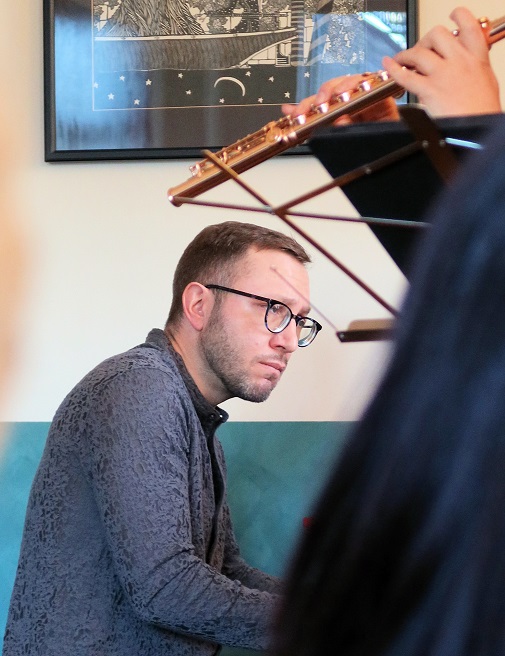
Unsung hero pianist Matthieu Cognet

Pianist Matthieu Cognet NYC 2025

In contrast, the second movement (Allegro) opened with dark, ominous piano. The flute followed, the instruments swirling around each other. A slower mid-section reduced the tension briefly. The movement ended with a brooding climb to a clattering climax.

The third movement (Ben moderato) followed attacca (immediately) with mournful piano and bird-like flute. There were hints of earlier movements, and of the upcoming finale. The movement closed wistfully with low flute over muted piano arpeggios.

The final movement opens with the famous A major theme that we had been waiting for, played canonically by each instrument. A winding series of crescendos lead to further canonical iterations before the work closed triumphantly.

Gabriel Fauré: Morceau de Concours (encore)

This beautiful, deceptively simple work made for an excellent close to the concert. It felt like a slow walk through a Monet painting, where the piano provided the footsteps and the flute was the afternoon breeze. The piano part is relatively subdued, but I was impressed by Mr. Cognet’s refined dynamics and his unexpected but effective accentuation of A3 in two places.

A Flutist’s Perspective

It can be hard to get good sound out of the lower range of a flute, and to play quietly in the high end. My flutist companion was in awe of Ms. Petrucci’s ability to project low notes loud and clear, and high notes so quietly. She admired her clean articulation and loved her vibrato.

For Franck’s sonata, Ms. Petrucci made adjustments to accommodate variances between violin and flute. Most obviously, the violin can play two notes concurrently (double stop), whereas the flute cannot. Also the range of the violin extends lower than that of the flute, necessitating octave changes or other adaptations.

Host Robin (center) with Matthieu and Ginevra

Closing Thoughts

Ginevra Petrucci and Matthieu Cognet played in perfect synchronization. When they shared the same melodic line, they sounded like one instrument. This allowed the refined elegance of these delectably French works to shine.

While we tend to focus on the flutist standing up front, the piano is an integral and essential partner in these sonatas. Mr. Cognet performed with admirable selflessness, seamlessly coordinating with the flutist while keeping a low profile to ensure that the audience was immersed in the musical flow.

Finally we note that we were listening to a solid 14k gold flute. Such instruments are prized for their rich tone, which Ms.  Petrucci took full advantage of.

Filed Under: Concerts, Private Concerts Tagged With: Cesar Franck, Flute, Gabriel Fauré, Ginevra Petrucci, Matthieu cognet, Robin Shoemaker

« Previous Page
Next Page »

©2025 Ken Turner | Roving Pianist


Loading Comments...
 

You must be logged in to post a comment.