ROVING PIANIST

WHO KNOWS WHERE HE WILL SHOW UP NEXT?

  • Home
    • Register
    • Log In
  • Concerts
    • Public concerts
    • Private Concerts
  • Quick Takes
  • Piano Blog
  • Other
  • Contact
  • About
    • About The Author
    • Privacy Policy
You are here: Home / Archives for Ken Turner

Nina Scheidmantel Carnegie Hall Debut

Monday, October 31st, 2016 by Ken Turner

Nina Scheidmantel at Carnegie

Nina Scheidmantel at Carnegie

On Saturday October 29, 2016, I went to Carnegie Weill to see pianist Nina Scheidmantel’s Carnegie debut recital. I had decided to attend based on her web site and some videos on YouTube. While the videos were quirky (in more than one her dress magically changed while she was on stage) I could see that she was capable.

Presented by the Artist

Nina’s recital was billed as “Presented by the Artist”, meaning that it was privately funded. I wondered if I might get to meet her manager and gain insight into how to set up such an event myself.

German-Chinese Pianist

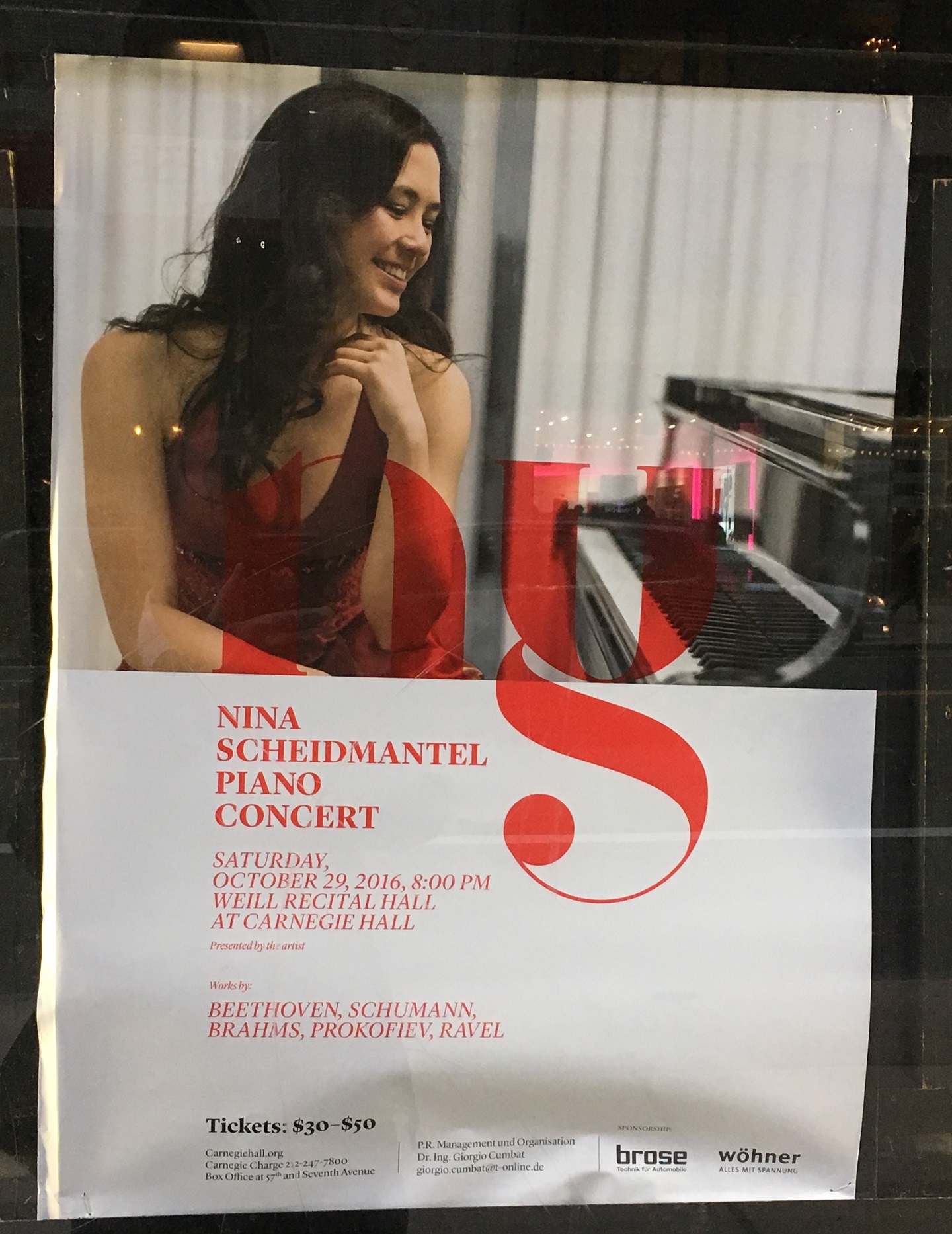
Two hours before Ms. Scheidmantel’s concert I stopped by at Carnegie to photograph her poster. An elfin gentleman in some kind of dress clothing appeared by my side, asking if he could interest me in the recital. When I showed him my ticket, we became instant friends.

It turned out that this affable gentleman was managing Ms. Scheidmantel’s recital. He told me that as a German-Chinese pianist, Ms. Scheidmantel had given recitals in China and earned interest from both Chinese and German authorities, some of whom were expected to attend this performance. It promised to be a great evening.

Balcony at Carnegie Weill

I had not been upstairs at Carnegie Weill before, and was delighted to find that my front and center keyboard-side seat was just perfect. Weill is small (around 260 seats) so even in the balcony I was closer to the performer than most of the audience are in the 2800-seat Stern Auditorium. I had brought my concert binoculars, but I did not need them.

Program and Artist

Nina’s program included Ravel, Beethoven, Schumann, Brahms and Prokofiev. After a brief announcement by the gentleman I had met earlier, Ms. Scheidmantel came on stage in an elegant floor-length black gown, with her hair up in a sparkling silver tiara. I was struck by how tall she was, and how much more Chinese she looked compared with her Carnegie Hall poster. Two of my favorite pianists (Lang Lang and Yuja Wang) are Chinese, so my expectations grew accordingly.

Of Pianists and Dragons

Ms. Scheidmantel attacked her Ravel vigorously. Although Valses Nobles et Sentimentales opens percussively, I have never thought of it as bombastic, but that was how Ms. Scheidmantel came across. Indeed, that was how she also played Beethoven, Schumann, and Brahms. At the end of each piece, she clenched her arms in a victorious flourish, as if she had just slain a dragon.

Release the Pedal, Nina!

Nina had a signature move where she would sustain a single note at the end of a section, long enough to transform it into something magical. Unfortunately she came off the pedal so slowly that sometimes she fell foul of damper mechanics. The resonating string would buzz for a long second, making it sound frayed. Was this a flaw in the regulation of the house Steinway, or should Nina have lifted her foot more decisively?

More Nuanced

I struggled to repress my discomfort at the endless Sturm und Drang of Nina’s performance. While I was struck by how physically powerful she was at the keyboard, I wish that she had included something more nuanced in her program. If I were her manager I would advise her to switch out Schumann in favor of something leaner. Chopin’s C minor Nocturne Op. 48 No 1 would have suited her style well and made for a rounder program.

Expectations

After the Brahms I felt that Nina had shown us everything that she could do, so I left. I felt good about supporting a relatively unknown artist, but bad that I had expected more of her than was reasonable. I was also disappointed at the choice of repertoire, which may have contributed to my perception of the pianist as a little heavy-handed.

The gentleman managing the recital had told me that this was not a publicity event so much as a family celebration and Nina’s personal dream. As a pianist myself I can relate to this dream, but when you sell tickets to the public you put yourself in the public eye, and the public has expectations.

Nina Scheidmantel – a Spirited Performance

Nina Scheidmantel carried off her Carnegie debut well for someone so early in her career. She appeared totally at ease and gave a spirited performance that speaks well for her future. I hope that as she matures artistically and her repertoire grows, we will see her again in New York.
Filed Under: Concerts, Public concerts Tagged With: Carnegie Hall, Carnegie Weill, China, Lang Lang, Nina Scheidmantel, piano, Yuja Wang

Kristian Bezuidenhout, Carnegie 2016

Sunday, October 30th, 2016 by Ken Turner

Kristian Bezuidenhout at Carrnegie Zankel 2016Bezuidenhout at Carnegie, October 2016

On Monday October 24th, 2016, my wife and I went to see pianist Kristian Bezuidenhout at Carnegie Hall, New York.  Actually I did not know this pianist, but the Carnegie Series that I subscribed to included his Beethoven-heavy program and it looked promising.

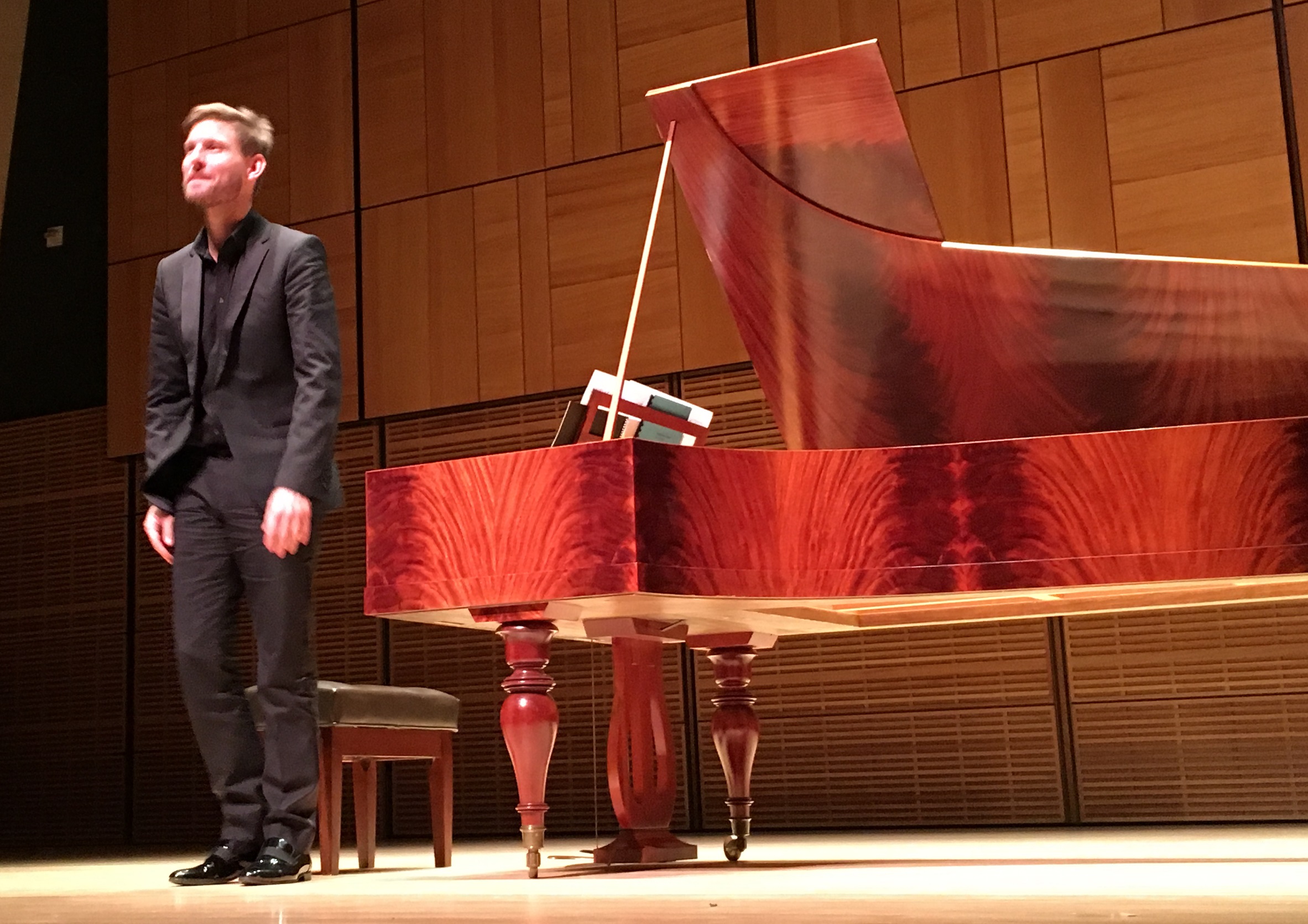
Mr. Bezuidenhout’s name sounds Dutch. In fact he is from South Africa, a former Dutch and British colony. He lives in London, from where his trendy cosmopolitan clothing, stylishly tight with rumples, may have come. His patent leather shoes had beech-colored soles that matched the matte wood of Carnegie Zankel.

Carnegie Zankel Hall

This was the first time I had been to Carnegie’s Zankel Hall. In photographs, Zankel looks modern and sharp. In person and up close from the Parterre, however, the luster was tired. The Hall smelled musty, and the stage front needed cosmetic work. Also, the Hall is a couple of levels below the ground, so from time to time I could hear the muffled bass of the New York Subway somewhere to stage right.

The Instrument

The piano was angular in design, with frond-like cinnamon artwork on the casing. Naïvely I assumed that this was a modernistic design in keeping with Zankel’s styling, but many readers will know better.

Fortepiano at Carnegie Zankel October 2016

Beethoven Rondo in C Major, Rondo in G Major

Bezuidenhout opened with two Beethoven Rondos. I was struck by the fineness of his touch and his ability to separate voices, especially at the lower end. It was as if each voice were suspended in its own acoustic space. In part this was because the piano lacked the power of the traditional concert grand, so there was less “bleed” from one register to another. In the acoustic intimacy of the 600-seat Zankel Hall, this made the instrument sound as beautiful as it looked.

Expression and Gesture

As a young man I attended several seasons of the Leeds International Piano Competition. There I saw many fine pianists, including Radu Lupu and Victoria Postnikova, but I don’t remember those performers as individuals. Now that I am older, I savor the uniqueness of each pianist’s personal nuances of expression and gesture. For this reason we splurged on front-row seats, which gave us an unparalleled view of Bezuidenhout on stage.

There was no cultivated drama in Bezuidenhout’s keyboard presence: his performance was all about the music. I noticed that Bezuidenhout’s eyebrows were always on the move. His use of sheet music had a less-desirable impact, however. Leaning low over the instrument, he had a particular rightward glance that might in other circumstances be seen as “giving the evil eye”. Try reading sheet music from a few inches above the left keys and you’ll get the idea.

Beethoven Sonata No. 7 in D Major

When Mr. Bezuidenhout moved to Beethoven’s Sonata No. 7 in D major, he drew the Largo out so exquisitely that I barely heard the rest of the piece or the subsequent Haydn.  Only the best pianists can capture my attention like this, so I will be scouring the web for more Bezuidenhout and for other renditions of this Sonata.

The Fortepiano

During the Intermission I browsed the program and discovered that the recital instrument was a not a piano, but a fortepiano. When Bezuidenhout returned, he gave an impromptu monologue about this instrument. He commented on the light action, the four pedals, how the strings were not cross-strung, and how the design gave the instrument its unique sonic character. In this modern replica, he explained, we were hearing the Viennese fortepiano as Beethoven would have known it.

Beethoven Sonata No. 8 (“Pathétique”)

The last scheduled piece was Beethoven’s Sonata no. 8 (“Pathétique”), a personal favorite that I never tire of. Mr. Bezuidenhout’s Carnegie performance was stellar. While the fortepiano lacked the low end power of a modern concert grand, Bezuidenhout’s interpretation retained all of the Sonata’s drama.

Excellent and Informative

As an encore, Bezuidenhout played a Beethoven-like piece that I could not identify. It was a fitting close to the evening’s 18th-century repertoire, performed on an 18th-century instrument replica. I enjoyed this recital much more than I had expected, and thanks to Mr. Bezuidenhout’s short lecture I learned more about the fortepiano. Now I just have to find a fortepiano that someone will let me play!


Filed Under: Concerts, Public concerts Tagged With: Beethoven, Bezuidenhout, Carnegie Hall, fortepiano, postnikova, radu lupu, Zankel Hall

Pianists with small hands

Saturday, June 25th, 2016 by Ken Turner

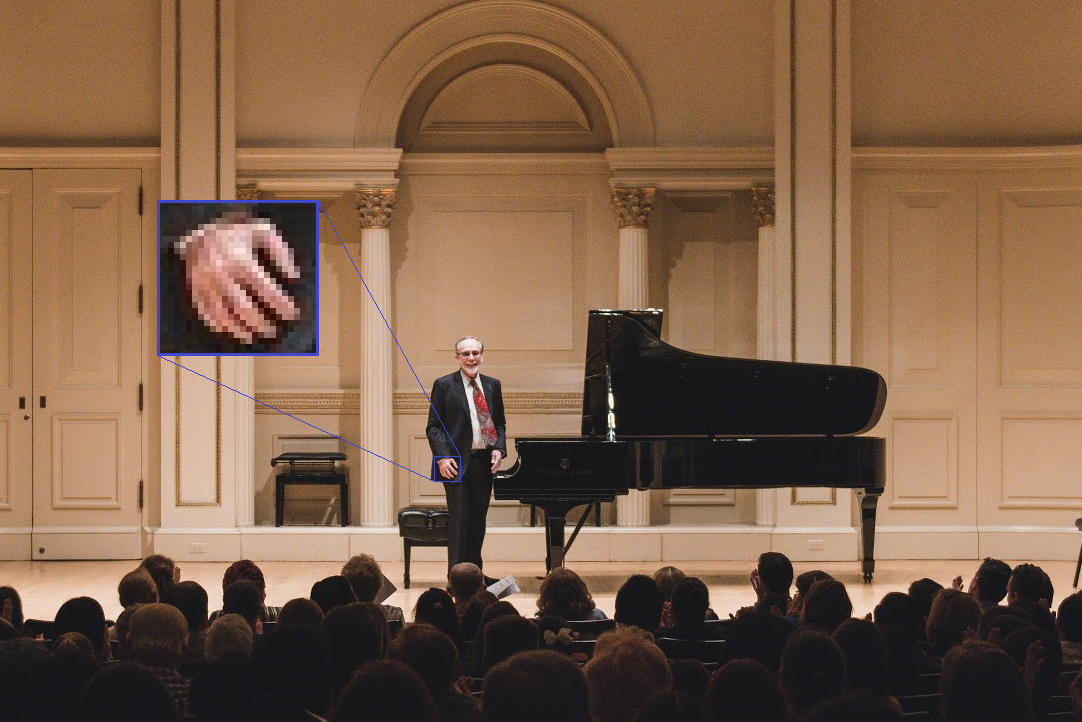
What does playing the piano do to your hands?

What playing the piano does to your hands

As a child I liked my small hands. They seemed appropriate for the son of writers. Marco Rubio‘s “if your hands are small we all know what else is small” exchange with Donald Trump was decades away.

Delicate hands

My mother told that me I had delicate hands. This became a metaphor for my life. Early in my career I had to fire someone. I could not do it, so I sat in my boss’s office to learn from a man with larger hands. But when he spoke to the employee, he stumbled. He was as sensitive as I, large hands notwithstanding.

Large Hands, Small Hands

If having big hands doesn’t make life easier, then having small hands shouldn’t make it more difficult. Or so I thought, until I took up learning the piano. I was half a century past the age when our hands are pliable enough to adapt physically to the instrument.

Rachmaninov, Liszt

At my first piano lesson, I could with forethought play an octave (an eight-note spread). A ninth was uncomfortable and a tenth impossible. I bought the scores of my favorite Rachmaninov piano preludes, but they contained chords that were too wide for my small hands. My dreams were shattered: I would never be able to wrap my fingers round the works of large-handed composers such as Liszt and Rachmaninov.

Virtual Hands

My teacher’s hands are tiny and yet she is a concert pianist. I asked her about those tenths, those 6-note chords and those unreachable arpeggios. I learned that what is written may not be what is played, and the audience may not notice or may not care. You can omit a note from a chord. You can break or arpeggiate a chord to reach unreachable notes. Such techniques create the illusion that you have played what you cannot play, making your virtual hand larger than your real one.

Sleight Of Hand

It is one thing to be aware of such techniques, and quite another to brave a piece that requires sleight of hand. But I am becoming aware, as my second year as an adult beginner pianist comes to a close, that something has happened to my hands. Those octaves are now easy, and a 9-note spread such as those in Beethoven’s Moonlight first movement no longer leaves my right hand hurting for days. Rachmaninov remains a challenge, but ever since I saw this exquisite performance by Marijan Djuzel I have had my eye on Rachmaninov’s Prelude Opus 23 No. 10 (watch this video, it’s impressive).

Does playing the piano change your hands?

A couple of weeks ago I got to play Chopin in New York. In a photograph taken at the time, I noticed that my right hand looks different. This might just be an illusion caused by loose, warmed-up hands, but I prefer to see it as a Lamarckian response to the demands of the piano. My hands appear to have gotten larger.

Filed Under: Adult Beginner Pianist, Favorites, Piano Blog Tagged With: Carnegie Hall, Donald Trump, Marco Rubio, Marijan Djuzel, pianist, Rachmaninov, small hands

« Previous Page
Next Page »

©2025 Ken Turner | Roving Pianist

Loading Comments...

You must be logged in to post a comment.