ROVING PIANIST

WHO KNOWS WHERE HE WILL SHOW UP NEXT?

  • Home
    • Register
    • Log In
  • Concerts
    • Public concerts
    • Private Concerts
  • Quick Takes
  • Piano Blog
  • Other
  • Contact
  • About
    • About The Author
    • Privacy Policy
You are here: Home / Archives for piano

Nina Scheidmantel Carnegie Hall Debut

Monday, October 31st, 2016 by Ken Turner

Nina Scheidmantel at Carnegie

Nina Scheidmantel at Carnegie

On Saturday October 29, 2016, I went to Carnegie Weill to see pianist Nina Scheidmantel’s Carnegie debut recital. I had decided to attend based on her web site and some videos on YouTube. While the videos were quirky (in more than one her dress magically changed while she was on stage) I could see that she was capable.

Presented by the Artist

Nina’s recital was billed as “Presented by the Artist”, meaning that it was privately funded. I wondered if I might get to meet her manager and gain insight into how to set up such an event myself.

German-Chinese Pianist

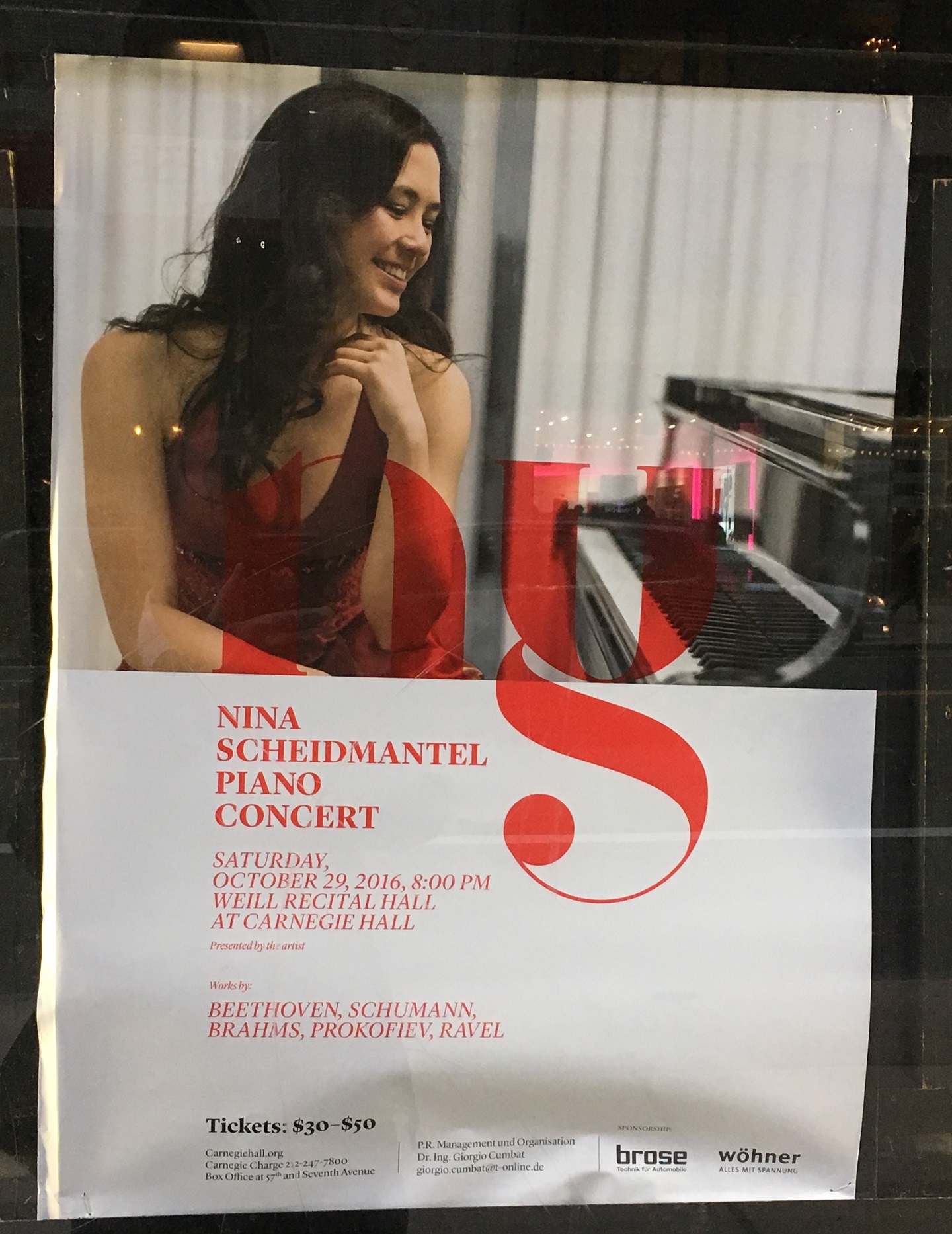
Two hours before Ms. Scheidmantel’s concert I stopped by at Carnegie to photograph her poster. An elfin gentleman in some kind of dress clothing appeared by my side, asking if he could interest me in the recital. When I showed him my ticket, we became instant friends.

It turned out that this affable gentleman was managing Ms. Scheidmantel’s recital. He told me that as a German-Chinese pianist, Ms. Scheidmantel had given recitals in China and earned interest from both Chinese and German authorities, some of whom were expected to attend this performance. It promised to be a great evening.

Balcony at Carnegie Weill

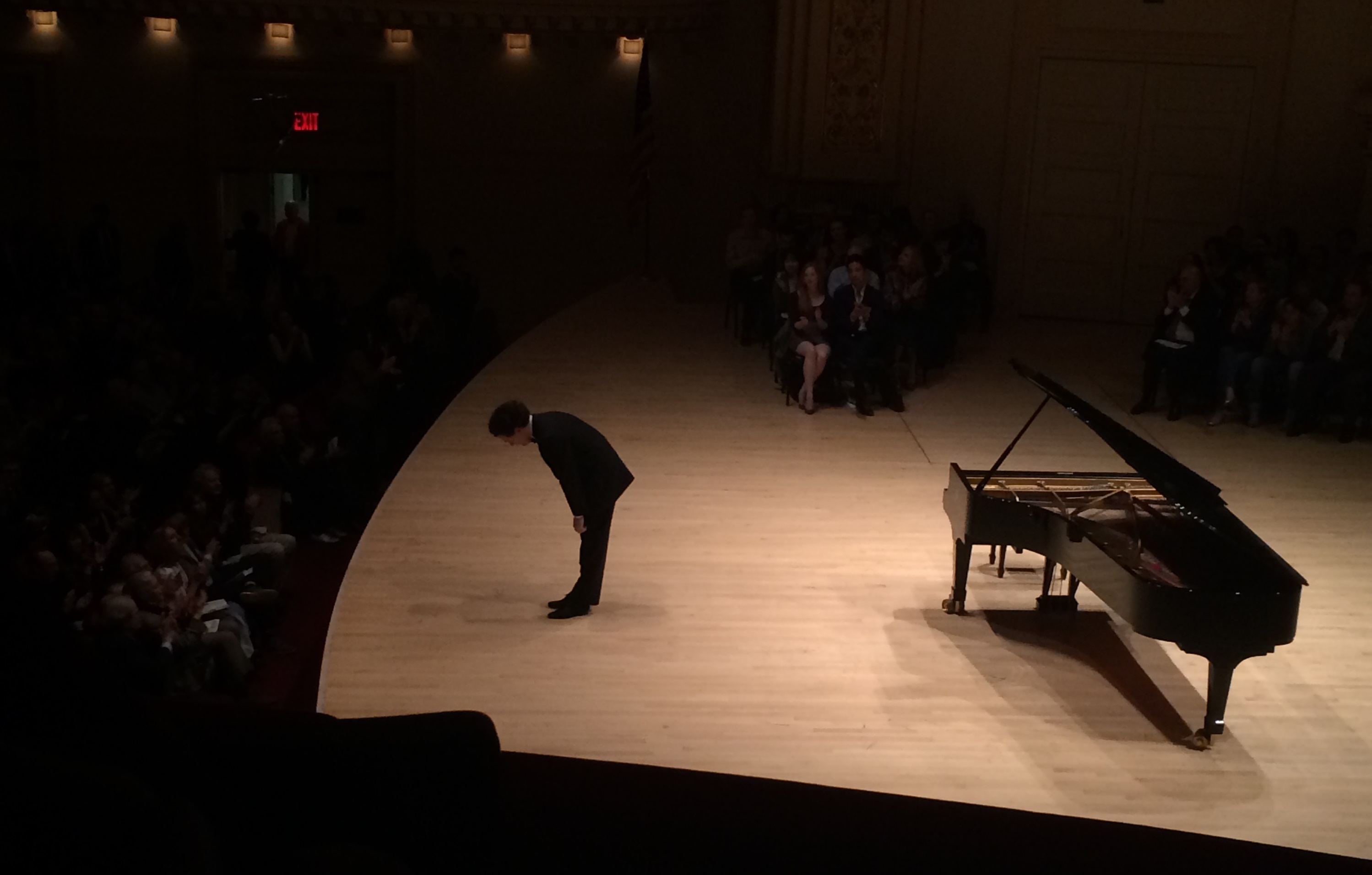
I had not been upstairs at Carnegie Weill before, and was delighted to find that my front and center keyboard-side seat was just perfect. Weill is small (around 260 seats) so even in the balcony I was closer to the performer than most of the audience are in the 2800-seat Stern Auditorium. I had brought my concert binoculars, but I did not need them.

Program and Artist

Nina’s program included Ravel, Beethoven, Schumann, Brahms and Prokofiev. After a brief announcement by the gentleman I had met earlier, Ms. Scheidmantel came on stage in an elegant floor-length black gown, with her hair up in a sparkling silver tiara. I was struck by how tall she was, and how much more Chinese she looked compared with her Carnegie Hall poster. Two of my favorite pianists (Lang Lang and Yuja Wang) are Chinese, so my expectations grew accordingly.

Of Pianists and Dragons

Ms. Scheidmantel attacked her Ravel vigorously. Although Valses Nobles et Sentimentales opens percussively, I have never thought of it as bombastic, but that was how Ms. Scheidmantel came across. Indeed, that was how she also played Beethoven, Schumann, and Brahms. At the end of each piece, she clenched her arms in a victorious flourish, as if she had just slain a dragon.

Release the Pedal, Nina!

Nina had a signature move where she would sustain a single note at the end of a section, long enough to transform it into something magical. Unfortunately she came off the pedal so slowly that sometimes she fell foul of damper mechanics. The resonating string would buzz for a long second, making it sound frayed. Was this a flaw in the regulation of the house Steinway, or should Nina have lifted her foot more decisively?

More Nuanced

I struggled to repress my discomfort at the endless Sturm und Drang of Nina’s performance. While I was struck by how physically powerful she was at the keyboard, I wish that she had included something more nuanced in her program. If I were her manager I would advise her to switch out Schumann in favor of something leaner. Chopin’s C minor Nocturne Op. 48 No 1 would have suited her style well and made for a rounder program.

Expectations

After the Brahms I felt that Nina had shown us everything that she could do, so I left. I felt good about supporting a relatively unknown artist, but bad that I had expected more of her than was reasonable. I was also disappointed at the choice of repertoire, which may have contributed to my perception of the pianist as a little heavy-handed.

The gentleman managing the recital had told me that this was not a publicity event so much as a family celebration and Nina’s personal dream. As a pianist myself I can relate to this dream, but when you sell tickets to the public you put yourself in the public eye, and the public has expectations.

Nina Scheidmantel – a Spirited Performance

Nina Scheidmantel carried off her Carnegie debut well for someone so early in her career. She appeared totally at ease and gave a spirited performance that speaks well for her future. I hope that as she matures artistically and her repertoire grows, we will see her again in New York.
Filed Under: Concerts, Public concerts Tagged With: Carnegie Hall, Carnegie Weill, China, Lang Lang, Nina Scheidmantel, piano, Yuja Wang

Kissin at Carnegie, November 2015

Sunday, December 20th, 2015 by Ken Turner

Evgeny Kissin at NYC Carnegie Hall

Evgeny Kissin after playing Beethoven at Carnegie Hall, November 3rd, 2015

I saw Evgeny Kissin perform on November 3rd, 2015 at Carnegie Hall, with my daughter Annie. We had fabulous seats over stage right. Could not see the keyboard, but that didn’t matter.  I was not there to learn anything, I was there to enjoy and to remind myself just how far I still have to go as a pianist.

A few weeks before this event, I had attended a Lang Lang recital at Carnegie. I was surprised that my pianist friends were not so thrilled about Lang Lang. The message I got was yeah, sure, Lang Lang is good but he’s not Kissin. Since I thought Lang Lang was awesome, my expectations on this night were extremely high.

The Stern Auditorium was packed. There were even seats on stage for about 100 people. Kissin did not keep us waiting like Lang Lang, and his shoes did not call out for attention. This was a performer who had no need to sell himself. He bowed both to the audience in the main hall, and to the lucky souls behind the piano who had wangled a seat on stage. Somehow, I felt that I was in the presence of greatness.

Warm-up candy: Mozart

The recital opened with Mozart’s Sonata in C Major.  This was pleasant and precisely articulated, but not the kind of music I would go out of my way to listen to. For Mr. Kissin, it was good warm-up candy before going for the big stuff.

Beethoven’s Appassionata Sonata

Beethoven’s Appassionata Sonata came next.  In comparison with Mozart’s little kitty-cat, Beethoven was a tiger that allowed Kissin’s mastery to shine. With his shaggy hair, you could have imagined that he was Beethoven himself. I can’t describe for you the power that Kissin has, and what it was like to listen to him play this monster of a sonata, but it left me stunned. I don’t know who I admire more, good old Ludwig or this fabulous Russian pianist.

Kissin’s Brahms Intermezzo #1 – MEH!

After the intermission, Kissin played 3 Brahms Intermezzos. I am particularly fond of #1, but I was disturbed at what felt like excessive rubato in his rendition.   I suppose that the greatest pianist in the world is entitled to play it his own way, but my “gold standard” is the one at this link: J. Brahms, Intermezzo op. 117. no. 1, Virna Kljakovic.

The rest of the evening was mostly Spanish (Albeniz, Larregla) music, which at any other event would have been captivating, but for me the concert really ended after Beethoven’s Appassionata, since I felt let down by the Brahms. Not even the strong delivery of Larregla’s Viva Navarra could offset the feeling that Mr. Kissin, world’s greatest pianist, didn’t “get” the Brahm’s Intermezzo. I imagine that he would disagree, but unfortunately I didn’t get to chat with him afterwards.

The bow says everything

When Mr. Kissin took his bows on this November night at Carnegie, he came forward and stood, head tilted back for a few seconds, radiant and gracious in our applause, before bowing.  It was as if he were transformed by music, and we with him.


Filed Under: Concerts, Public concerts Tagged With: Beethoven, Brahms, Carnegie Hall, Intermezzo, Kissin, Lang Lang, Mozart, pianist, piano, Virna Kljakovic

Tempo Rubato

Sunday, September 20th, 2015 by Ken Turner

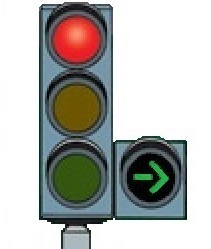
Red light with green filterDrivers slip into the Exit Only lane to get past traffic at a red light. When the light changes, they do not exit. Instead they cut in ahead of the rest of the traffic. The time they save is stolen time – tempo rubato.

Those who cut ahead of us on the highway, at the store, at the bus stop, may be your neighbor, my child, anyone. They get to their destination faster, by delaying those whom they pass. I doubt that they consider themselves thieves, but they steal.

In music, rubato takes various forms. You can hold back for just a moment. You can speed and slow over several bars. In Armenian composer Khachaturian’s piano concerto, a conductor can use rubato to make the entire work heave like a vessel in heavy seas.

At the piano, rubato can be like traffic on a multi-lane highway. One hand maintains the tempo while the other speeds and slows, but never breaks entirely free from the flow. Time is not stolen, it is borrowed and returned.

One time I was running late driving to my piano lesson. Never mind that my tutor might also be behind schedule: I did not want miss a moment. I like to get to music school early to inhale the ambience and ogle the Steinways. And it is oddly soothing after a draining day at work, to exchange a nod and a smile with parents waiting for their kids, those same parents who are there at the same time every week, waiting for the same kids.

When I got to Rubato Red traffic light, the Exit Only lane was open. Like those rats who cut me off every day, I took it. When the light turned green I unleashed 450 ft/lbs of gut-wrenching BMW diesel torque and reclaimed 20 seconds of my life, proceeding stretto to class.

Filed Under: Piano Blog Tagged With: BMW, Khachaturian, pianist, piano, rubato, tempo rubato, time

« Previous Page
Next Page »

©2025 Ken Turner | Roving Pianist


Loading Comments...
 

You must be logged in to post a comment.